A universal meeting allows Swiss companies to adopt valid resolutions without formal convening, provided all shareholders are present or represented and no objections are raised. This article explains the legal requirements, typical pitfalls and how Konsento enables transparent and legally compliant digital universal meetings.
Introduction
The universal meeting stands out for its exceptional flexibility: all shareholders are present or represented by a proxy, no objections are raised, and the company can therefore adopt valid resolutions at short notice without having to comply with the formal requirements for convening and agenda-setting of a general meeting. This also applies to resolutions that require public notarisation.
At the same time, it requires particular legal care: if a shareholder ultimately fails to attend or definitively leaves the meeting early, the universal meeting ends immediately. All resolutions adopted thereafter are null and void.
This article explains the legal framework, practical requirements and key points to watch – and shows how the Konsento application helps companies conduct universal meetings efficiently and in full compliance with the law.
Table of contents
- What defines a universal meeting
- Legal framework and requirements
- Special features and typical pitfalls
- Conducting universal meetings digitally with Konsento
What defines a universal meeting
A universal meeting exists when all shareholders are present or represented and none objects to the meeting being held in this form. Under these conditions, the following formal requirements can be fully waived:
- formal convening
- compliance with the 20-day notice period
- a pre-defined agenda
- proposals by the board of directors
It is not a special type of general meeting, but a special form of how the meeting is conducted.
From a practical perspective, however, the absence of an agenda and proposals must be viewed with some nuance: shareholders are unlikely to attend a meeting if they do not know what will be discussed. In order to ensure the participation or representation of all shareholders, the board of directors will therefore usually include at least a minimal agenda with the invitation. Moreover, since the usual statutory requirements for the minutes also apply to a universal meeting, it is advisable, for reasons of efficiency, to formulate the proposed resolutions as precisely as possible already at the invitation stage.
In practice, the main simplification therefore lies in waiving the form and notice period for convening the meeting.
The obligation to keep minutes always applies
Even in the case of a universal meeting, the requirements of Art. 702 CO regarding the minutes apply. The minutes must include at least the following:
- the chair,
- the secretary,
- the vote counter (if required),
- details of the categories of shares and votes represented,
- the resolutions and voting results,
- any requests for information raised at the meeting and the responses given,
- statements by shareholders recorded in the minutes,
- any technical issues that occurred.
Legal framework and requirements
Presence of all shareholders and absence of objections – the core element
The decisive requirement is that all shareholders are present or represented and that no one objects to holding the meeting as a universal meeting. These facts must be recorded in the minutes, even though Art. 702 CO does not explicitly require this. Otherwise, doubts could later arise as to whether the waiver of formal convening was lawful, potentially rendering the resolutions contestable.
As soon as a shareholder definitively leaves the meeting, the requirement that all shareholders be present or represented is no longer fulfilled and the universal meeting comes to an end.
All resolutions adopted thereafter are null and void. Only those resolutions adopted while all shareholders were still present or represented remain valid.
Any remaining matters must be resolved at a further general meeting, which must be convened either in the formally prescribed manner or, depending on the participation rate, again as a universal meeting.
Board of directors and other participants
Members of the board of directors also have the right to attend and speak at a universal meeting; the board of directors as a body additionally has the right to submit proposals (Art. 702a CO). However, the validity of the universal meeting and the resolutions adopted does not depend on the presence or approval of board members who do not themselves hold shares. The board of directors must be informed of the resolutions adopted without delay.
Participants
If the company has participation capital, the rights of participants pursuant to Art. 656c and 656d CO must also be taken into account. Since a universal meeting can validly adopt resolutions without prior notice and without the presence of board members, this is generally also considered permissible vis-à-vis participants, provided they are not exceptionally granted a statutory right to attend. In any event, participants must be informed of the resolutions adopted without delay.
Decision-making powers
At a universal meeting, all matters falling within the competence of the general meeting may be resolved, including resolutions requiring public notarisation. Even though the law requires the participation of all shareholders, unanimity is of course not required for each individual proposal. Resolutions are adopted in accordance with the usual voting quorums set out in Art. 703 and 704 CO or in the articles of association.
Conducting universal meetings digitally with Konsento
The Konsento application provides comprehensive support for universal meetings, including public notarisation and all guided steps required for fully compliant documentation.
Formal requirements are monitored automatically
By default, the application highlights the statutory convening requirements, in particular the 20-day notice period.
In the case of a universal meeting, this requirement can be deliberately overridden.
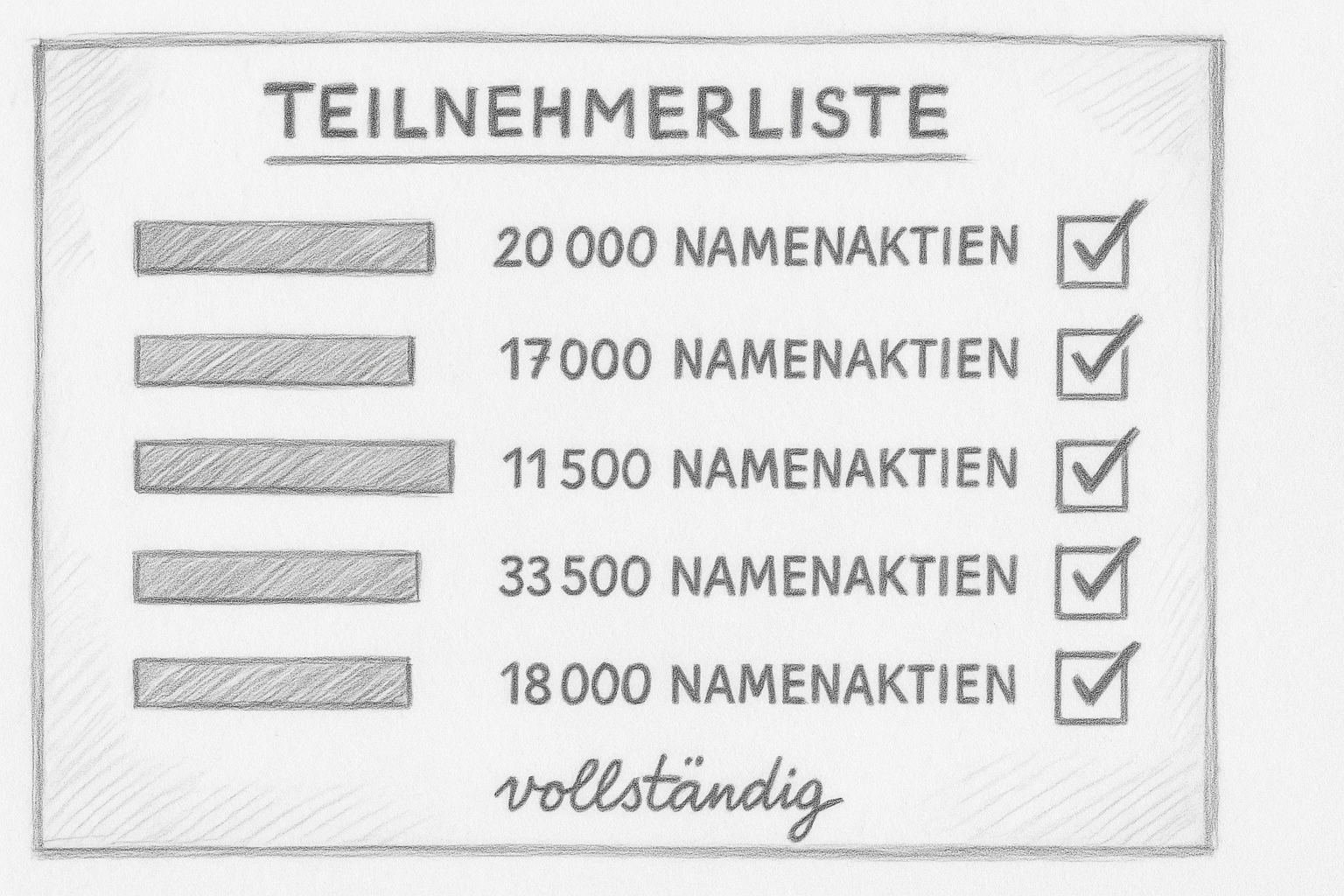
Transparency regarding the presence of all shareholders
In the overview of each general meeting, the board of directors can see at any time:
- which shareholders have confirmed their participation,
- who has already exercised their voting rights via a proxy,
- whether the requirements for a universal meeting are fulfilled.
With a single click, delinquent shareholders can be reminded – ideal for continuously monitoring and supporting the successful formation of a universal meeting.
Automatic inclusion of participants
If participants exist, the application automatically informs them about the holding of the general meeting, including all information relevant to them.
Simple, fast and legally compliant execution
- guided processes,
- automated minutes,
- validations based on company law,
- support for resolutions requiring notarisation (including notary).
For any further questions relating to company law or the Konsento application, the Konsento AI chatbot is available around the clock.
Conclusion
The universal meeting is a flexible but legally demanding instrument. It is essential that all shareholders are present or represented and that no objections are raised – and that the company clearly documents when these conditions are met and when they are not.
Due to the high requirements regarding participation and the absence of objections, the universal meeting is generally better suited to smaller corporations with up to approximately ten shareholders. In companies with a broader shareholder base, ensuring the short-notice participation of all shareholders can be challenging. In such cases, a proxy general meeting or a virtual general meeting is usually more appropriate for efficiently adopting specific resolutions outside an ordinary general meeting.
With Konsento, execution of a univeral assembly becomes simpler, more transparent and legally secure – without media breaks and with clear processes for every type of resolution.
Register now on Konsento and independently set up your universal meeting for a resolution requiring notarisation. Our AI chatbot will guide you step by step through the process. And if you prefer a personal conversation with the Konsento team, this option is also available to support the planning of your next universal meeting.