About Konsento

Konsento is an independent Swiss LegalTech platform that digitizes and simplifies legal processes relating to share capital. Since 2021, we have been supporting Swiss SMEs — from startups to established companies — in the efficient, legally compliant processing of share registers, general meetings, board meetings and capital increases.

Our intelligent platform connects founders, boards of directors, shareholders and external service providers such as notaries or auditors in a secure, structured workflow. Developed by an interdisciplinary team of lawyers, IT and finance specialists, continuously optimized for seamless corporate actions.

Already implemented:
350+ general meetings
100+ Corporate Actions
21,000+ users — especially shareholders and participants
More than 450 Swiss stock companies rely on Konsento — for greater clarity, security and efficiency in equity management.

No credit card required
Can be canceled at any time

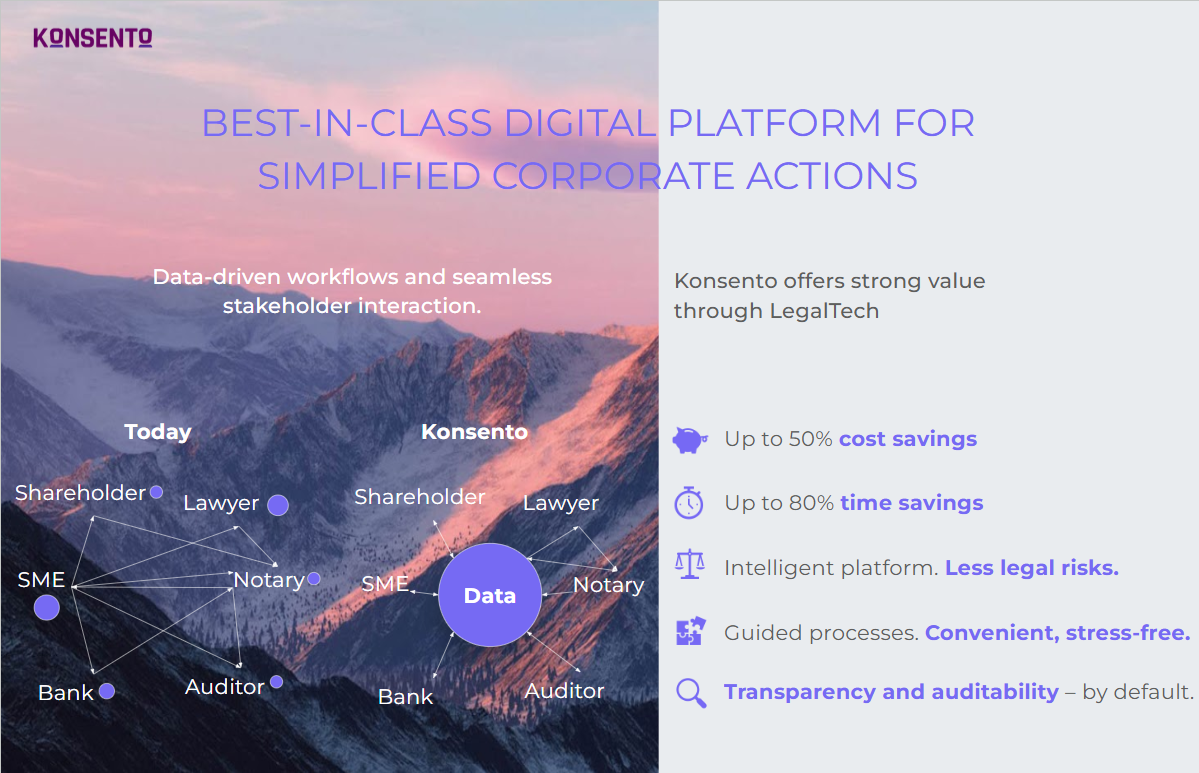
Simplify legal workflows and focus on what matters.

Konsento is the intuitive governance platform that helps you stay compliant, in control, and one step ahead. With powerful tools tailored to Swiss stock corporations, you can simplify complex legal tasks and act with confidence.

70%

Our customers report massive time savings in all relevant corporate actions.

60%

Fewer legal risks thanks to clearly managed processes and integrated legal logic.
Unsere Team-Mitglieder

Get to know the experts behind Konsento

Dominik Witz
Founder
Sandro Stricker
Founder
Flurin Schenkel
CTO
Arnaud Beuret
Member of the Board of Directors
Dr. iur. Pascal Zysset
Advisory Board
Marco Fehr
Advisory Board
Dr. Tina Störmer
Advisory Board
Andreas Santarsieri
Project Advisor
Sascha Gysel
Advisory Board
Harald Schnabel
Advisory Board
Fredy R. Flury
Advisory Board

550+ Aktiengesellschaften vertrauen uns
Gain peace of mind by simplifying complex governance tasks.

FAQ

Frequently asked questions

What if I cannot clearly verify the beneficial owner's identity?

In that case, this must be disclosed in the report and all available relevant information must be submitted, along with the most senior member of the governing body as the designated contact person (Art. 9 para. 3 LETA and Art. 12 LETO).

When does a control chain need to be reported?

The obligation is triggered in particular when a trust or at least two intermediate levels stand between the beneficial owner and the company, or when a fiduciary relationship forms part of the control chain (Art. 7 para. 1 LETO).

What is meant by control exercised in other ways?

This refers to situations in which control is not exercised through capital or voting right percentages, but for example through the right to appoint or remove the majority of board members, through veto rights, or through the right to determine profit distributions. The LETO requires a description of how that control is specifically exercised (Art. 3 and Art. 8 LETO).

Do I need to submit a change notification for every small share transfer?

Not necessarily. A change notification is triggered in particular when a transfer causes a reporting threshold to be crossed upward or downward (Art. 18 para. 3 LETO).

Do I need to report even if a single person holds 100 percent of the shares?

Yes. The reporting obligation applies even in the simplest of structures. What must be reported are identity data as well as information on the nature and extent of control (Art. 9 LETA in conjunction with Art. 6 LETO).

How does Konsento support the transfer of my company’s registered office in Switzerland?

Konsento supports you throughout the entire process of transferring your company’s registered office – from preparation to registration in the Commercial Register. The platform ensures that all legal steps are implemented correctly and efficiently. This includes preparing the shareholders’ meeting with a legally compliant agenda item for the transfer. The resolution can be adopted electronically via a written circulation process, enabling a lean and compliant execution. In addition, Konsento organises the notarisation through an online notary and prepares all required documents, including the amendment of the articles of association, the Commercial Register application and the certification of signatures of authorised representatives. Where required, a domicile declaration is also included. Finally, Konsento handles the submission and processing of the application with the Commercial Register, ensuring an efficient and legally secure process without media disruption.

What documents are required for a change of address?

A change of address requires: – A simple written application to the Commercial Register by the board of directors – If a c/o address is used: a declaration of domicile acceptance

What documents are required for a transfer of registered office?

The following documents must be submitted: – Public deed of the shareholders’ resolution – Updated certified articles of association – Commercial Register application signed by authorised signatories – Where applicable, a declaration of domicile acceptance

Does a change of address require notarisation?

No. A change of address within the same municipality only concerns the address and not the legal seat. It does not require an amendment of the articles of association and therefore no notarisation. A simple filing by the board of directors is sufficient.

Does a transfer of registered office require notarisation?

Yes. A transfer of registered office results in an amendment of the articles of association and must therefore be documented by a public deed, i.e. notarised (Art. 647 CO in conjunction with Art. 25 CommRegO).

Who decides on a transfer of registered office or a change of address in a Swiss company?

The shareholders’ meeting decides on a transfer of registered office to another municipality and this requires an amendment of the articles of association (Art. 698 para. 2 no. 1 CO). A change of address within the same municipality is decided by the board of directors (Art. 716a CO), as no amendment of the articles is required.

What is the difference between a transfer of registered office and a change of address in a Swiss company?

A transfer of registered office means moving the legal seat to another municipality. This requires an amendment of the articles of association and must be notarised. A change of address, by contrast, only affects the business address within the same municipality and does not require an amendment of the articles.

How does Konsento support the convening and execution of general meetings?

Konsento provides a digital platform for organizing, conducting, and automatically documenting general meetings. It helps ensure compliance with notice periods, enables legally compliant delivery of invitations, and automatically tracks receipt by shareholders. This reduces legal risks and allows you to run your general meeting efficiently, transparently, and with minimal effort.

What notice period applies to the general meeting of a Swiss corporation?

Swiss law requires a minimum notice period of 20 days for general meetings (Art. 700 CO). This period protects shareholder rights and ensures that shareholders have sufficient time to prepare. Failure to comply may result in the resolutions being challenged.

What is the principle of receipt for general meeting invitations?

The principle of receipt means that an invitation becomes legally effective only when it reaches the shareholder, i.e. enters their sphere of control and can be taken note of under normal circumstances. It is not necessary for the shareholder to actually read the invitation. The risk of delayed delivery lies with the company.

How do I correctly calculate the notice period for convening a general meeting?

The notice period is at least 20 days before the date of the general meeting (Art. 700 CO). Neither the day of the meeting nor the day of receipt of the invitation is counted. It is a full intermediate period. What matters is that the invitation reaches the shareholder no later than 20 days before the GM – not when it is sent.

Can subsequent contributions be carried out fully remotely with Konsento?

Yes, large parts of the process can be handled digitally and without unnecessary media discontinuities. This includes in particular the digital board resolution, online signatures, coordination of all parties and online notarisation.

What services does Konsento provide for subsequent contributions?

Konsento supports the entire process digitally: from the board resolution through templates, coordination with the bank and the notary, capital contribution account and reconciliation of payments through to commercial register filing and updating of the share register.

Is a notary required for subsequent contributions?

Yes, the completion of subsequent contributions generally includes a resolution subject to notarisation. Therefore, public notarisation by a notary is required before filing with the commercial register.

How are subsequent contributions carried out in practice?

As a rule, the obligated shareholders pay the outstanding amount into a capital contribution account. Subsequently, the payment is confirmed by the bank, the completion is determined by the board of directors, notarised and filed with the commercial register.

Who decides on subsequent contributions in a Swiss corporation?

Subsequent contributions are resolved by the board of directors. This is not a resolution of the general meeting, but a measure falling within the competence of the board of directors.

What added value does Konsento provide in relation to the exclusion of voting rights?

Konsento significantly reduces the risk of challengeable resolutions by implementing the exclusion of voting rights automatically at system level. Errors due to manual allocation or lack of awareness are avoided, and the general meeting can be conducted efficiently, transparently and in full legal compliance.

How does Konsento ensure that excluded shareholders cannot vote?

When setting up the general meeting in Konsento, shareholders who have participated in management can be technically excluded from voting on the discharge agenda item. These shareholders can still see the discharge item in the GM tool, but they are not given any voting options. This ensures that inadmissible votes cannot be cast.

Does the exclusion of voting rights also apply if a board member represents other shareholders?

Yes. The exclusion applies regardless of whether a board member votes in their own name or as a representative of other shareholders. What matters is who actually makes the voting decision. If a conflict of interest exists due to involvement in management, represented votes are also subject to the exclusion.

Who is excluded from voting on the discharge?

All persons who have participated in the management of the company in any way are excluded from voting (Art. 695 CO). This includes not only members of the board of directors, but also members of executive management, de facto governing bodies, and any other persons exercising significant influence over the company.

What are the legal limits of the discharge?

The effect of the discharge is clearly limited by law. It only covers disclosed facts (Art. 758 CO), does not bind creditors, and does not affect direct claims of individual shareholders (Art. 754 CO). In addition, shareholders who did not approve the discharge retain their right to bring claims for a transitional period of twelve months following the resolution (Art. 758 para. 2 CO).

What legal effect does the discharge have under Swiss law?

The discharge limits the enforcement of liability claims, but only with respect to disclosed facts and vis-à-vis a specific group of persons (Art. 758 CO). It is effective towards the company and shareholders who approved the discharge or who acquired their shares thereafter in knowledge of the resolution. It does not constitute a full waiver of liability.

What is the legal basis of the discharge of the board of directors?

The discharge is anchored in Swiss company law as a non-transferable power of the general meeting (Art. 698 CO). It is closely linked to the liability regime of the board of directors (Art. 754 CO) and the statutory provisions governing its effects (Art. 758 CO). Together, these rules define when and to what extent a discharge is legally relevant.

Can Konsento itself act as an independent proxy?

Yes. Upon request, Konsento can assume the role of independent proxy in general meetings conducted on the platform. This naturally only occurs where the legal requirements for independence are fulfilled.

Can a representative be explicitly designated as an independent proxy in Konsento?

Yes. In Konsento, representatives can be explicitly marked as independent proxies. This information is visible to shareholders in the general meeting interface and helps them choose an appropriate representative. The designation is also reflected in the voting results and in the automatically generated minutes.

Why is it useful for the board of directors of a non-listed corporation to proactively appoint an independent proxy if the articles of association provide that shareholders may only be represented by other shareholders at the general meeting?

Especially in companies with many shareholders, shareholders often do not know each other and generally have no easy way of contacting other shareholders to ask them to represent them at the general meeting. Even if some contact exists, it would hardly be reasonable to expect shareholders to make significant efforts to organise representation. From the shareholders’ perspective, it is therefore much more practical if the board of directors provides an independent proxy from the outset.

What is the benefit for shareholders if the board of directors appoints an independent proxy?

Such a voluntary solution can be particularly useful if several shareholders are unable to attend the general meeting in person or if the board of directors wishes to ensure neutral and transparent voting representation.

Can the board of directors of a non-listed company always nominate an independent proxy?

Yes. The board of directors of a non-listed corporation may also appoint an independent proxy voluntarily, even if there is no legal obligation to do so. If an independent proxy is appointed voluntarily, care should be taken to ensure that the person is genuinely independent and that no conflicts of interest exist. This corresponds to the purpose of the legal rules governing the independent proxy (Art. 689c–689d CO).

How does Konsento support proxy voting at the general meeting?

In the general meeting tool of Konsento, proxies can easily be recorded and managed. Proxies can also be explicitly designated as independent proxies. This information is visible to shareholders in the meeting tool and enables a transparent selection of the desired proxy. During the general meeting, the proxy’s status is clearly indicated: in the overview of represented votes, in the voting results, and in the automatically generated minutes. Upon request, Konsento may also act as the independent proxy at general meetings, naturally only where the statutory independence requirements are fulfilled.

May an independent proxy be economically dependent on the company?

Economic dependence may impair independence (Art. 728 para. 2 no. 5 CO). This may be the case, for example, if an adviser or trustee derives a substantial portion of their income from mandates with the company. According to the ExpertSuisse independence guidelines, economic dependence is often assumed where a single client accounts for around 30% or more of annual revenues over several years. Although this threshold does not directly apply to independent proxies, it illustrates the underlying principle: a person who is economically dependent on the goodwill of the company is unlikely to be perceived as fully independent.

When can a financial interest compromise independence?

Independence may be impaired if the proxy holds a direct or significant indirect shareholding in the company (Art. 728 para. 2 no. 2 CO). An indirect participation may arise, for example, through a holding company, an investment fund or a related entity. The law does not define specific thresholds. In practice, however, reference is often made to the independence guidelines issued by ExpertSuisse. These guidelines generally consider an indirect financial interest to be significant if it exceeds approximately 10% of the person’s equity or net assets. While this threshold does not directly apply to independent proxies, it provides a useful indication.

What does “independence” mean for an independent proxy?

The independence of the independent proxy must not be impaired either in fact or in appearance (Art. 689b para. 4 CO). To clarify this requirement, the law refers to the independence rules applicable to statutory auditors (Art. 728 paras. 2–6 CO). These rules are intended to ensure that the proxy exercises the shareholders’ voting rights in a neutral manner and without conflicts of interest. Particularly problematic are close organisational, economic or personal relationships with the company or with its decision-makers.

When must a non-listed Swiss company appoint an independent proxy?

A non-listed Swiss corporation must appoint an independent proxy if its articles of association provide that shareholders may be represented at the general meeting only by other shareholders (Art. 689d para. 1 Swiss Code of Obligations). In such a case, a shareholder may request that the board of directors designate an additional representative to whom shareholders may delegate their voting rights. This may be either an independent proxy or a corporate proxy (Art. 689d para. 2 CO). However, corporations may also appoint an independent proxy voluntarily at any time. The board of directors must inform shareholders no later than ten days before the general meeting whom they may appoint as their proxy (Art. 689d para. 3 CO).

Can AGM minutes be digitally signed and archived in Konsento?

Yes. AGM minutes can be signed directly in Konsento using a qualified electronic signature. Alternatively, they can be exported as a PDF, signed by hand, and then uploaded back into Konsento. In both cases, the documents can be securely archived and shared with the shareholders.

Wie hilft Konsento kleinen Aktiengesellschaften bei der Erstellung eines GV-Protokolls?

Konsento erstellt für kleine Aktiengesellschaften mit bis zu drei Aktionären automatisch eine sogenannte GV-Schnellversion. Daraus kann mit wenigen Klicks ein vollständiges, rechtskonformes Protokoll der Generalversammlung erstellt werden, ohne dass Traktanden manuell vorbereitet oder Abstimmungen organisiert werden müssen

What information must be included in the minutes of the General Meeting?

Swiss company law defines a minimum content for the minutes of the General Meeting. This includes, in particular, the resolutions adopted by the General Meeting as well as the results of votes and elections. In practice, AGM minutes also contain information about the number of shares and voting rights represented at the meeting, as well as the agenda items that were discussed.

Who must sign the minutes of the General Meeting?

The minutes of the General Meeting must be signed by the chair of the General Meeting and the minute-taker (Art. 702 para. 3 CO). These roles may also be performed by the same person. The minutes can be signed either by handwritten signature or by means of a qualified electronic signature.

Must every Swiss corporation prepare minutes of the General Meeting?

Yes. Swiss company law requires every corporation, regardless of its size or the number of shareholders, to hold an ordinary General Meeting once a year and to record minutes of every General Meeting (Art. 702 CO). The minutes serve as the official record of the resolutions adopted and are an important document for the company’s corporate governance.

How does the concept of control under the Transparency Act (for reporting to the Transparency Register) differ from the concept of control under the Investment Screening Act (IPG)?

The two concepts of control serve different purposes and differ both in their structure and in their practical application. Under the Transparency Act, the aim is to identify natural persons who actually control a company — that is, those who exercise direct or indirect decisive influence and therefore must be reported in the Transparency Register (Transparency Act Art. 2–3 TJPV). Control by shareholding: A natural person controls a company if they directly or indirectly hold at least 25 % of the capital or voting rights (Art. 2 para. 1 TJPV). Control in other ways: A natural person also controls a company if, for example, they can appoint more than half of the board members, have a veto over decisions, or otherwise exert decisive influence (Art. 3 para. 1–2 TJPV). The Transparency Act therefore adopts a relatively broad concept of control that considers both shareholding thresholds and other avenues of influence to determine who actually governs the company. By contrast, the Investment Screening Act (IPG) defines control not with a view to natural persons, but in connection with takeovers by investors. Control in the IPG context means that an investor directly or indirectly acquires control over a company, typically through a merger, the acquisition of a stake, or the conclusion of a contract (Art. 2 lit. a IPG). The decisive point here is that a previously independent company can be economically and legally dominated by an investor. The focus is on the entry of the investor into a dominant position, not on identifying individual controlling persons.

How can companies already prepare today for the reporting obligations under the Transparency Act?

Companies can prepare effectively by clarifying and documenting their ownership structure at an early stage. This includes identifying the beneficial owners and systematically recording the relevant information. Early preparation reduces time pressure, minimises errors and significantly facilitates later reporting to the transparency register.

Can a change in the commercial register trigger the reporting deadline earlier?

Yes. A first change entered in the commercial register after the entry into force of the Transparency Act may trigger the reporting deadline independently of the general transitional period. In such cases, the reporting period begins with that change, even if the ordinary transitional period has not yet expired. Companies should therefore carefully plan any commercial register changes after the Act enters into force.

Which transitional periods apply to the reporting of beneficial owners to the transparency register?

The Transparency Act does not provide for a single uniform transitional period. The applicable deadlines depend on the legal form, audit status and complexity of the ownership structure. In simple cases where all beneficial owners are already identifiable from the commercial register, a transitional period of up to two years applies. In all other cases, significantly shorter deadlines of three to six months apply.

From when does the reporting obligation to the transparency register apply under the Transparency Act (TJPG)?

The reporting obligation to the transparency register generally arises upon the entry into force of the Transparency Act (TJPG). From that date, obliged legal entities must identify, document and report their beneficial owners to the transparency register within the statutory deadlines. The obligation arises automatically by operation of law and does not depend on a prior request by the authorities.

What needs to be done with the existing register of beneficial owners?

The existing register of beneficial owners remains relevant under the Transparency Act. Information already collected and documented under current law can generally continue to be used, provided that it complies with the new legal requirements and is up to date. In addition, such records must be retained for ten years. Companies should therefore review, update and archive their existing register in an audit-proof manner.

Why does the board of directors need specific regulations for holding general meetings using electronic means?

The board of directors’ regulations specify the statutory requirements for virtual or hybrid general meetings and ensure that such meetings are conducted in compliance with the law. They set out in a binding manner how electronic means are to be used, which organisational and technical requirements apply and how shareholders’ rights are safeguarded. The regulations therefore provide legal certainty for the board of directors and transparency for the shareholders.

Which matters must the board of directors’ regulations on the use of electronic means at the general meeting specifically address?

The regulations must define how the identity of shareholders participating electronically is clearly established. They must also ensure that statements can be made immediately and without filtering during the discussion of the relevant agenda items. In addition, the regulations must govern the right of all participants to submit motions and take part in discussions, as well as the correct and unaltered determination of voting results, in particular to prevent multiple or contradictory exercises of voting rights in the case of electronic participation.

Why should the rules on the use of electronic means at the general meeting be set out in the board of directors’ regulations rather than in the articles of association?

Regulating these matters in board regulations allows for a flexible and practical design of the organisational and technical requirements applicable to virtual and hybrid general meetings. Unlike the articles of association, the regulations can be amended by the board of directors at any time without a resolution of the general meeting, public notarisation or registration with the commercial register. This flexibility is particularly important in view of the rapid technological development of electronic means, whereas the articles of association should remain limited to fundamental and long-term structural matters.

How can shareholders be integrated into Konsento’s processes if they do not have an email address or do not wish to provide one?

The email address is the central access key to Konsento. It enables shareholders to securely access the platform, receive electronic invitations to general meetings, and obtain tax certificates, relevant documents, as well as ongoing news & updates. Konsento delivers its full efficiency benefits for the company when all shareholders are digitally integrated. In practice, this form of communication is valued by shareholders across all age groups. At the same time, Konsento also addresses the needs of shareholders who do not have an email address or who prefer not to receive documents electronically. For such cases, Konsento offers flexible solutions to ensure reliable communication via analogue channels. All content generated in Konsento – including tax certificates, proofs of ownership, invitations to general meetings, and minutes of general meetings – can be exported as PDFs at the push of a button, printed, and sent by postal mail at any time. In this way, Konsento combines the efficiency of the digital world with the reliability of traditional communication channels, without any loss of information and without additional administrative effort for the company.

How can my company prepare for reporting to the transparency register?

Early analysis of ownership and control structure is crucial, as implementation deadlines can be short depending on the legal form and size of the company. Companies should systematically record and document their shareholder and ownership relationships today. With Konsento's digital share register, beneficial owners can be properly identified and the necessary information for future reporting can be prepared in compliance with the law – thus avoiding time pressure and compliance risks.

What happens when reporting to the transparency register if no beneficial owner can be identified?

If, despite careful examination, no beneficial owner can be identified – for example in cases of widely dispersed shareholdings – a subsidiary rule of the Transparency Act applies: the most senior member of the executive body is then considered the beneficial owner, typically the chair of the board of directors. This rule primarily serves to ensure contact with authorities and does not mean that this person actually exercises economic control.

Can multiple persons be considered beneficial owners jointly?

Yes, the Transparency Act expressly covers joint control. When multiple persons exercise their voting rights in a coordinated manner or coordinate on the acquisition of holdings, all persons involved are considered beneficial owners – even if their individual holding is below 25%. Typical examples are shareholder groups with voting agreements, investor syndicates, or communities of heirs who collectively exercise their rights.

How does indirect control through intermediate companies work in the transparency register?

The Transparency Act also covers indirect control. This exists when a natural person controls more than 50% of one or more intermediate companies that in turn hold at least 25% in the target company. This control can operate across multiple levels and also through multiple holdings held in parallel. The analysis must therefore consider all ownership chains – regardless of whether the intermediate companies are domiciled in Switzerland or abroad.

At what ownership level is someone considered a beneficial owner under the Transparency Act?

Under the Transparency Act, a natural person is considered a beneficial owner when they hold at least 25% of the capital or voting rights of a company. This threshold applies to both direct and indirect holdings – regardless of whether the holding is held alone or in concert with others. Important: Even without reaching this ownership level, someone can be considered a beneficial owner if control by other means exists – for example through veto rights or the right to appoint the majority of the board of directors.

Can I also conduct universal meetings requiring notarisation with Konsento?

Yes. Konsento also supports resolutions requiring notarisation within the framework of universal meetings, including public notarisation. The application guides users through all legally relevant steps in a structured manner and ensures complete and compliant documentation.

How does Konsento ensure that the requirements for a universal meeting are met?

Konsento provides a transparent overview within the general meeting dashboard, showing at all times which shareholders have confirmed their participation or have submitted their votes via a proxy. Missing responses can be followed up with a single click. This allows the board of directors to continuously verify whether the requirements for a universal meeting are fulfilled.

What are the advantages of holding a universal meeting with Konsento compared to a traditional, analogue setup?

With Konsento, you can set up general meetings using a wizard-based, guided workflow that already takes the relevant legal requirements into account. With a single click, all shareholders can be invited directly from the share register. The information rights of any participants (Art. 656c and 656d CO) are automatically considered by Konsento. Legally compliant agenda items can be selected from a list of templates with just a few clicks and adapted if required. The handling of invitations, proxy voting instructions and registrations is fully automated. The participation or proxy voting instructions of all shareholders – which are essential for holding a universal meeting – can be monitored in real time via a clear and intuitive dashboard. The minutes are generated automatically. For any further legal or application-related questions, both an AI chatbot and the Konsento team are available to assist you. With Konsento, conducting universal meetings is easier than ever.

What happens if a shareholder leaves the universal meeting before it ends?

If a shareholder definitively leaves the universal meeting, the requirement that all shareholders be present or represented is no longer fulfilled. The universal meeting ends at that moment. All resolutions adopted thereafter are null and void; only those adopted beforehand remain valid. Any further resolutions require the convening of a new general meeting.

Do resolutions at a universal meeting have to be adopted unanimously?

No. Although the participation of all shareholders is required, unanimity is not required for individual resolutions. Resolutions are adopted in accordance with the ordinary or qualified majorities set out in Art. 703 and 704 CO or in the articles of association.

What are the key requirements for a valid universal meeting?

A universal meeting is only valid if all shareholders are present or duly represented and no shareholder objects to holding the meeting as a universal meeting. These requirements must be recorded in the minutes. If any of these conditions is not met, there is no valid universal meeting. (Art. 701 CO).

How can I carry out a subsequent contribution more easily and cost-effectively with Konsento?

With Konsento, you can set up the required board meeting in just a few clicks – including a pre‑formulated agenda item and automatically generated resolution minutes. The Commercial Register filing is also prepared for you. The notary joins the meeting online and produces the public deed digitally – entirely without an in‑person appointment. Konsento arranges the notary and schedules the meeting for you. You no longer need a lawyer for this process. This turns your subsequent contribution into a streamlined, efficient standard procedure.

Are there specific formal requirements for carrying out a subsequent contribution?

Yes. The outstanding contributions must be paid into a blocked capital contribution account with a Swiss bank. The board resolution must be recorded in writing and notarised. The articles of association must be updated and certified by a notary. The entire procedure must be filed with the Commercial Register so that the fully paid-up capital is officially recorded and published.

Who is competent to approve the subsequent contribution?

According to Art. 634b CO, the resolution on the subsequent contribution lies within the competence of the board of directors. This means that convening and holding a general meeting is not required.

What is the difference between a subsequent contribution and the payment up of outstanding contributions on partially paid-in shares?

Both terms refer to the same process, which is governed by Swiss company law in Art. 634b CO.

What information must shareholders report to the company under the Transparency Act?

Shareholders must inform the company of the following: who the beneficial owner is, the beneficial owner’s full name, date of birth, nationality and country of residence, the nature and extent of the control exercised, any changes to this information (within one month). Upon request, they must also provide additional documents needed to verify the identity of the beneficial owner.

Why are shareholders/partners and beneficial owners required to report information themselves under the Transparency Act?

Because only they know whether they are acting on their own behalf or on behalf of someone else. Many control structures — such as nominee arrangements, silent agreements or multi-layered ownership chains — are not visible to the company. Without their active cooperation, the company cannot fulfil its own duties of identifying, verifying and reporting.

Who is subject to the Legal Entity Transparency Act (LETA)?

LETA applies to all legal entities under Swiss private law (e.g. AG, GmbH, cooperatives, SICAV/SICAF) as well as certain foreign legal entities with a close connection to Switzerland (property ownership, a branch office, or effective administration in Switzerland). The only exemptions are listed companies and their majority-owned subsidiaries, as well as associations and foundations.

Which documents must be signed manually or with a Qualified Electronic Signature (QES) in a corporate action context?

Written form – or its digital equivalent, the Qualified Electronic Signature (QES) – is required for a range of key documents in corporate action processes. This includes, in particular, minutes of the general meeting and the board of directors, assignment/transfer declarations required for the valid civil transfer of shares, tax certificates, set-off declarations used for the conversion of convertible loans into shares, board reports for capital increases, Lex Koller/Friedrich declarations, commercial register filings, acceptance declarations for corporate office, as well as other documents for which statutory written form is mandated. All of these documents can be prepared and executed through the Konsento platform.

What is a Qualified Electronic Signature (QES)?

A Qualified Electronic Signature (QES) is the most secure form of digital signature and is legally equivalent to a handwritten signature in both the European Union and Switzerland. It is based on a qualified digital certificate issued by a recognised certification authority, following a formal identity verification of the signatory. In Switzerland, the QES is expressly deemed equivalent to a handwritten signature pursuant to Art. 14 para. 2bis CO. It may therefore be used to sign any contract, deed or document for which the law requires written form.

Are foreign legal entities also subject to LETA?

Yes. Foreign entities are subject to LETA if they have a relevant connection to Switzerland, such as effective management carried out in Switzerland, ownership of Swiss real estate, or the operation of a branch registered in the Swiss Commercial Register. Examples include UK Limiteds, Delaware LLCs, or French SARLs managed from Switzerland.

Which legal entities are explicitly exempt from the reporting obligations under the Legal Entity Transparency Act (LETA)?

Under LETA, listed companies whose equity securities are wholly or partly traded on a stock exchange, subsidiaries more than 75% owned by such listed companies, and occupational pension institutions are exempt. These entities are not required to report beneficial owners to the Transparency Register.

Which Swiss legal entities are subject to the Legal Entity Transparency Act (LETA)?

LETA applies to virtually all legal entities under Swiss private law, including AGs (joint-stock companies), GmbHs (limited liability companies), partnerships limited by shares, cooperatives, SICAVs, SICAFs, and limited partnerships for collective investment schemes. All these entities must identify and report their beneficial owners.

How can companies prepare today for the new obligations under the Transparency Act?

The Transparency Act will come into force in mid-2026, but it is worth preparing now: Companies should review their ownership and control structures, document chains of participation and clearly record all beneficial owners. With Konsento's digital share register, this data can already be mapped in a structured manner, reviewed and prepared for future reporting to the transparency register – in a legally compliant and efficient manner.

What happens if a company cannot clearly identify the beneficial owners?

In this case, the company must: document all clarifications undertaken, and submit a replacement notification in which the highest management body (e.g. chair of the board of directors) is reported as the beneficial owner. This ensures that the transparency register remains complete even if no controlling person can be clearly identified.

What information must companies obtain about their beneficial owners in accordance with the Transparency Act?

The company must record far more than just names and dates of birth. Mandatory information includes: type and extent of control (sole, joint, direct, indirect, through participation or other means), participation category (25–50%, 50–75%, over 75%), the complete chain of control including all intermediate legal entities with VAT number, country of domicile and legal form, and clear proof of identity (AHV number or identity document).

Who is considered an beneficial owner within the meaning of the Transparency Act?

Any natural person who ultimately controls a company by holding, directly or indirectly, alone or in concert with third parties, at least 25 per cent of the capital or voting rights in that company, or who controls it in any other way, is considered to be the beneficial owner of that company.

How much does Konsento’s digital share register cost?

Konsento’s digital share register is free of charge for up to 150 shareholders. For companies with more shareholders, we provide a customised offer.

How can I import my existing share register using Konsento’s AI solution?

Register your company at https://app.konsento.ch/auth/new-register . In the first step, simply enter your company name – Konsento automatically retrieves the public data from the commercial register and pre-fills the form for you. Right after that, you can upload your existing share register in Word, Excel, or PDF format. The entire process – from entering your company name to uploading your register – takes less than 10 seconds. We then use our artificial intelligence to extract and structure your existing share register and populate your digital share and transaction register in Konsento. After that, everything undergoes a thorough manual quality check, and we’ll get in touch with you once it’s completed.

How does Konsento help companies improve their corporate governance?

Konsento enables startups and SMEs to manage corporate governance digitally, efficiently, and in full legal compliance. The platform offers centralized shareholder and board management, automated minutes, and legally compliant documentation of all corporate actions. This helps companies meet governance standards, build investor trust, and enhance valuation in funding rounds.

What are the most common governance mistakes that lead to valuation discounts?

Typical issues include opaque cap tables, unclear decision-making processes, missing board meeting minutes, and undefined roles within the founding team. Mixing personal and business interests is another major red flag for investors. These weaknesses erode trust – and directly lower company value.

How much does corporate governance affect a startup’s valuation?

Strong corporate governance can increase a company’s valuation by up to 30% – or reduce it by the same margin if lacking. Investors assess ownership transparency, board quality, decision documentation, and how conflicts of interest are managed. Weak governance often results in valuation discounts and stricter contract terms during due diligence.

How are identification and the Qualified Electronic Signature connected?

Before a QES can be issued or used, the signer’s identity must be formally verified once. Today, this is typically done via Video-Ident or Self-Ident procedures. In the future, the Swiss e-ID will simplify this process, as it will provide a state-verified digital identity. The QES is therefore built directly on secure identification: only an individually verified person can create a legally binding digital signature. The combination of e-ID and QES ensures digital processes that are both efficient and legally sound.

Can I sign documents with a Qualified Electronic Signature (QES) on Konsento?

Yes. The Konsento platform already supports QES workflows from leading Swiss signature providers. Directors, shareholders, investors, and notaries can sign legally binding documents directly within Konsento – including meeting minutes, share transfer deeds, subscription forms, and commercial register filings. Once the e-ID becomes available, it will serve as a verified digital identity for QES use, making the signing process even faster and smoother.

Which corporate action documents must be signed using a QES?

In corporate action processes, any document requiring legal written form must be signed with a QES. This includes: Minutes of general meetings and board meetings, Subscription forms and set-off declarations in capital increases, Capital increase reports by the board of directors and notarial deeds, Commercial register filings and certifications. The Konsento platform enables all these steps to be completed digitally, securely, and in full legal compliance, using qualified electronic signatures and integrated authentication.

Which type of electronic signature is legally equivalent to a handwritten signature?

The Qualified Electronic Signature (QES) is the only form of electronic signature that is legally equivalent to a handwritten signature. It fulfils the formal requirements of Articles 13 and 14 of the Swiss Code of Obligations (CO), in particular Art. 14 para. 2bis CO, which states that a QES has the same legal validity as a handwritten signature. This means that all documents requiring written form can be signed digitally with full legal effect.

How can the e-ID be used in Corporate Action processes?

The e-ID can be used in the context of Corporate Actions to securely authenticate shareholders, board members, and notaries – for example during virtual general meetings, the identification of beneficial owners, or electronic notarizations. This makes legal processes faster, more efficient, and tamper-proof. Konsento will integrate the e-ID into its workflows as soon as the first e-IDs are issued.

How does the e-ID differ from existing identification methods?

Unlike Self-Ident or Video-Ident procedures, which must be repeated for each service, the e-ID is verified once by the federal authorities. It can then be used for all digital applications. This saves time, reduces costs, and significantly enhances security.

What is the e-ID and what is it used for?

The e-ID is Switzerland’s new official digital identification system. It enables individuals to prove their identity online securely and reliably – whether when interacting with authorities, banks, or platforms such as Konsento. It removes the need to undergo a separate identification process for every provider.

How can Konsento support the board of directors in a situation of over-indebtedness?

Konsento enables boards to carry out capital increases efficiently, securely and entirely online when facing over-indebtedness. The platform assists in planning and implementing all resolutions, automatically generates the necessary documents for the board, notary and commercial register, allows online notarization by an authorized notary, and submits the registration electronically – all without administrative effort or physical presence. Especially during a restructuring phase, this process is also highly cost-efficient, as automation and online notarization significantly reduce legal and administrative expenses.

What is the difference between capital loss and over-indebtedness?

A capital loss occurs when equity falls below half of the share capital and statutory reserves. Over-indebtedness arises when assets no longer suffice to cover all liabilities, resulting in negative equity.

What measures must the board of directors of a Swiss AG take in the case of over-indebtedness?

The board must prepare an interim balance sheet, have it audited and, if there is objective under-coverage, notify the court – unless sufficient creditor subordination exists.

What is over-indebtedness under Swiss law?

Over-indebtedness exists when a company’s assets are no longer sufficient to cover all its liabilities – the equity is essentially exhausted.

What does Art. 725 CO state?

Art. 725 CO stipulates that the board of directors must act immediately in the event of a capital loss or imminent over-indebtedness – for example by convening a general meeting, preparing an interim balance sheet or notifying the court.

Can I also manage participation certificates in Konsento?

Yes. Konsento’s digital register management fully supports participation capital and participation certificates. As with shares, you can record assignment declarations and link them to the corresponding transactions. The system automatically generates a transaction register and a participant register, calculating each investor’s exact share of equity and voting rights, taking into account the entire share and participation capital. The general meeting module also automatically complies with the legal information duties under Art. 656c and 656d CO: participants are informed in due time about the convening of the general meeting and its agenda – digitally and without manual effort.

What is the difference in dilution between a capital increase through shares and through participation capital?

A capital increase through share capital (Art. 650 et seq. CO) issues new voting shares, which dilutes the voting power of existing shareholders. A capital increase through participation capital (Art. 656a et seq. CO), by contrast, creates no voting rights, meaning existing shareholders’ control remains unchanged. Only their economic share in profits or equity may shift. This form of financing is therefore well suited for companies wishing to raise funds without transferring decision-making power.

What are participation certificates?

Participation certificates, as defined in Art. 656a para. 2 CO, are securities that represent a share in a company’s equity without voting rights. Holders of participation certificates (participants) enjoy essentially the same economic rights as shareholders, including the right to dividends (Art. 660 CO), subscription rights (Art. 652b CO), and liquidation proceeds (Art. 745 para. 1 CO). The company’s articles may, under Art. 656b CO, grant preferential rights such as preferred or cumulative dividends to compensate investors for the absence of voting rights.

Our latest posts

AirVault webflow template image

Legal Entity as Independent Proxy: What Swiss Law Allows – and What It Means in Practice

This article explains under which conditions a legal entity may act as an independent proxy. It outlines the legal requirements regarding independence, binding instructions, and liability, and illustrates the practical implementation in general meetings.

AirVault webflow template image

Change of address or transfer of registered office: When is a public deed required?

A change of address only affects the business address within the same municipality and can be resolved by the board of directors. A transfer of the registered office involves relocating the legal seat to another municipality and requires a shareholders’ resolution, an amendment of the articles and a public deed.

AirVault webflow template image

Convening the General Meeting: What Swiss Corporations Must Consider for Timely Invitations

Timely convening of a general meeting is essential for the legal validity of resolutions. This article clearly explains the principle of receipt, shows how to correctly calculate the 20-day notice period under Art. 700 CO, and highlights the practical differences between invitations by post and email. With concrete examples and actionable guidance, you get a clear framework for delivering invitations in a legally compliant way and avoiding risks.

AirVault webflow template image

Exclusion of Voting Rights on Discharge: Who May Not Vote at the General Meeting

This article explains when voting rights are excluded in connection with the discharge of the board of directors and who may not vote at the general meeting. It covers typical scenarios such as board members as shareholders, representation situations and group structures. It also outlines the legal risks of non-compliance with Art. 695 CO.

AirVault webflow template image

What Does the Discharge of the Board of Directors Really Do? Effects and Limits Explained

The discharge of the board of directors is a key resolution of the general meeting. It signals shareholder approval but also affects liability claims. This article explains how the discharge works, its limits and which risks remain under Swiss law.

AirVault webflow template image

When does a non-listed Swiss company need an independent proxy?

Many boards assume that independent proxies only matter for listed companies. In practice, non-listed Swiss corporations may also need one, for example in virtual general meetings or when representation rights are restricted. This article explains when an independent proxy is required, the legal framework under Swiss corporate law and how boards of directors should address voting representation at general meetings.