
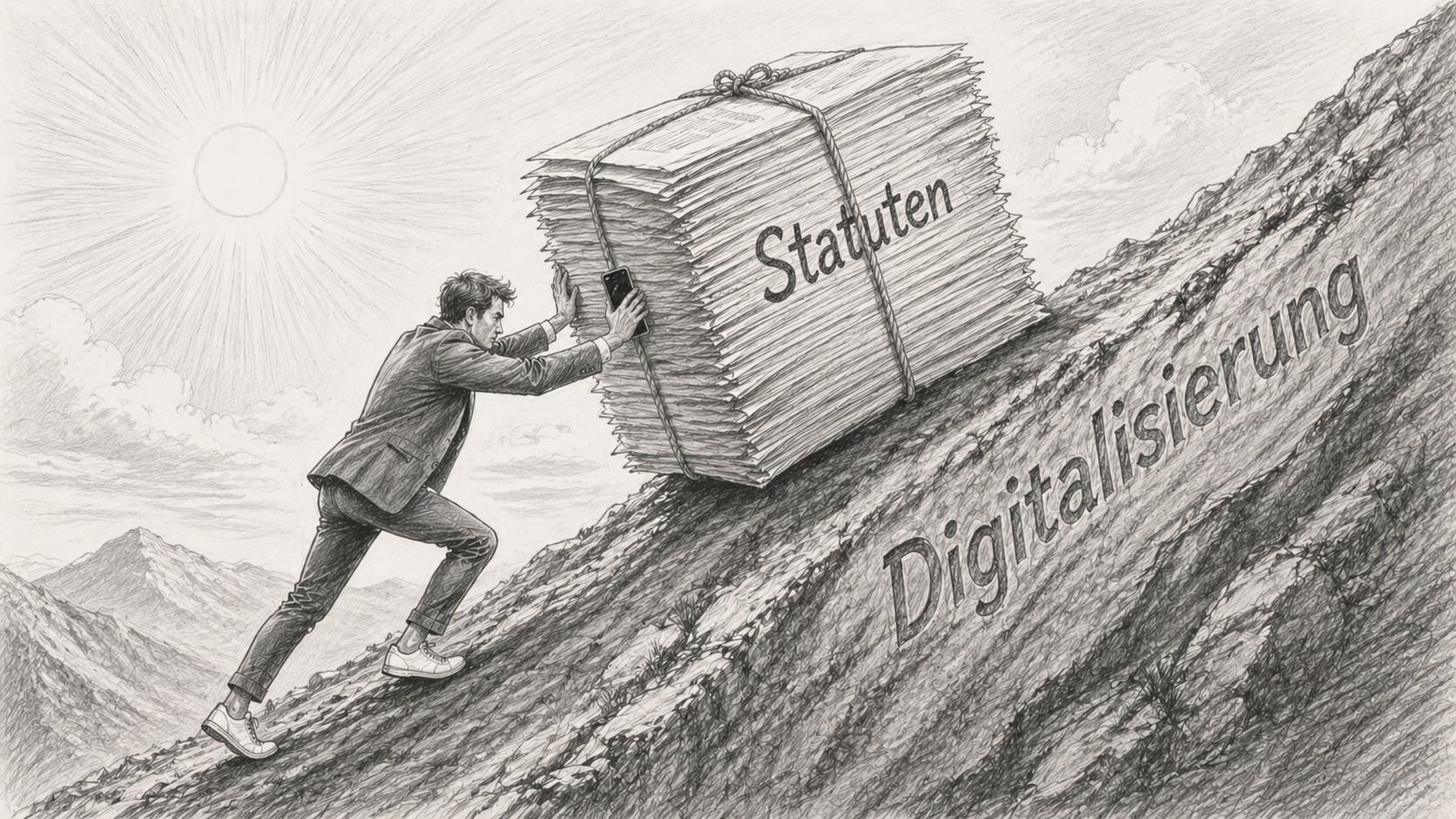
Many stock corporations hold their general meetings virtually and dematerialise their shares without their articles of association reflecting this approach. This article shows which formulations on convocation, communications, proxies, the virtual general meeting and the form of shares typically stand in the way of digitalisation. It draws on the relevant provisions of the revised Swiss company law (Art. 626, 689, 700, 701a et seq., 973c, 973d CO) and on the case law of the Swiss Federal Supreme Court regarding the right to physical share certificates. It closes with a practical overview of what distinguishes digitalisation-ready articles of association today.
Stock corporations increasingly communicate with their shareholders by electronic means, hold their general meetings virtually or in hybrid form, and refrain from issuing physical share certificates. This reflects the everyday reality of board members, executives and shareholders who sign contracts electronically, hold meetings by video and exchange documents through cloud platforms. Corporate practice has thus moved markedly away from the traditional paper-based world.
The legal basis for this shift, however, does not follow automatically. Anyone who wants to digitalise corporate housekeeping and dematerialise the shares must make sure that the company’s own articles of association allow for it. In practice, a recurring pattern emerges: the articles act as a brake because they contain wording that tacitly assumes paper and physical presence. This article shows which typical provisions stand in the way of digitalisation and what distinguishes truly digitalisation-ready articles of association.
Table of Contents
- Why the articles of association determine the path to digitalisation
- Typical pitfalls in existing articles of association
- What distinguishes digitalisation-ready articles of association
- Conclusion
Why the articles of association determine the path to digitalisation
The articles of association form the constitutional foundation of every stock corporation. They define how the company is organised, how it communicates with its shareholders and in which form it adopts resolutions. The Swiss Code of Obligations sets out a mandatory minimum content (Art. 626 CO) but expressly refers many additional questions to the articles. When it comes to convening the general meeting, representing shareholders, certificating shares and, in particular, holding a purely virtual general meeting, the law opens up scope that a company can only use if its articles expressly anchor it.
From this follows a principle of considerable practical importance: digital tools and electronic processes alone are not enough. Without a corresponding internal legal basis, digitalisation remains a factual practice that any shareholder can legitimately challenge at any time. The articles must not run counter to the company’s digitalisation efforts; instead, they must provide the internal legal foundation for them.
Typical pitfalls in existing articles of association
When reviewing existing articles of association, the same weaknesses tend to appear time and again. They often date back to a period when corporate housekeeping and shareholder communication were almost exclusively organised on paper. The following five points show where digitalisation readiness most frequently fails.
Convening the general meeting
From a legal perspective, the convocation qualifies as a communication from the company to its shareholders, and its form is governed by the relevant provisions of the articles (Art. 626 para. 1 no. 7 CO in conjunction with Art. 700 CO). If the articles require the convocation to be sent “by letter”, “by registered letter” or simply “in writing”, the path to an electronic convocation is blocked. Under Swiss law, the term “in writing” as a rule means paper bearing a handwritten signature or, where transmitted electronically, a qualified electronic signature (Art. 14 para. 2bis CO). For sending invitations to a multi-member shareholder base, this requirement is hardly workable in practice.
Anyone wishing to send invitations by e-mail or via a platform therefore needs an explicit opening clause in the articles. A clean wording allows convocation “in writing or in electronic form, for example by e-mail, sent to the address most recently entered in the share register”. Without this basis, electronically delivered invitations are open to challenge, and resolutions of a meeting that has not been duly convened are voidable under Art. 706 para. 1 CO.
Communications to shareholders
The same logic applies to all other communications from the company to its shareholders, such as the publication of resolutions, the dispatch of the annual report and audit report or information on capital measures. If the articles refer only to “written” form, “letter” or even “fax”, electronic channels are effectively blocked. This is particularly relevant in light of Art. 626 para. 1 no. 7 CO, under which the form of communications to shareholders must be set out in the articles. The same channel can also be used to make the annual report and audit report available to shareholders electronically before the general meeting (Art. 699a para. 3 CO), thereby eliminating the physical inspection requirement at the company’s registered office.
The appropriate wording here, too, is “in writing or electronically, in particular by e-mail or through an electronic communication platform”. Only then is the board of directors in a position to use modern tools without incurring a formal risk every time something is sent out.
Proxies and proxy voting
Older articles of association often contain rigid requirements regarding representation at the general meeting (Art. 689 et seq. CO). A typical formulation is that shareholders may be represented “by written proxy”. Strictly speaking, this calls for a paper-based proxy or, if submitted electronically, a qualified electronic signature. For practically relevant workflows such as electronic proxy granting by e-mail, through an online portal or in connection with a virtual general meeting, this is a substantial obstacle.
A digitalisation-ready clause permits the granting of a proxy “in writing or in electronic form”, thus covering both the paper proxy with a handwritten signature and electronic empowerment through simple, practical channels.
Virtual and hybrid general meetings
Since 1 January 2023, the revised Swiss stock corporate law has given stock corporations new options for holding their general meetings. The law allows general meetings at several venues simultaneously (Art. 701a para. 2 CO), at a venue abroad (Art. 701b CO), with electronic participation by shareholders not present at the venue (Art. 701c CO) and as purely virtual general meetings without any physical venue at all (Art. 701d CO).
A company can only benefit from these options if its articles of association create the corresponding basis. The purely virtual general meeting and a venue abroad both require an explicit provision in the articles. Without it, the board of directors may organise an in-person meeting with electronic participation but cannot dispense with a physical venue. For an internationally oriented or geographically dispersed shareholder base, this is a significant restriction.
As an additional lever, Art. 701d para. 2 in conjunction with Art. 704 para. 1 no. 15 CO allows non-listed companies to provide in their articles that no independent proxy needs to be appointed. For a lean, low-bureaucracy virtual general meeting with a manageable shareholder base, this is a very useful building block.
Excluding physical share certificates
A particularly sensitive issue in practice concerns the certification of shares. Many companies assume that maintaining a digital share register automatically displaces paper shares. The Swiss Federal Supreme Court, however, made clear in a 2021 decision that this is not enough: in the absence of an express provision in the articles excluding physical share certificates, a shareholder can successfully sue for the issuance of a share certificate, even if the company already manages its shares internally in dematerialised form.
That decision remains fully relevant three years after the entry into force of the revised company law and concerns every stock corporation that has structured its shares as uncertificated securities within the meaning of Art. 973c CO or as ledger-based securities under Art. 973d CO. Without a clear provision in the articles, there is a risk that paper shares will return “through the back door”: individual shareholders insist on receiving their shares as certificates, and the board of directors must comply. All the benefits of dematerialisation are then lost, from protection against loss to ease of transfer.
An effective rule therefore unambiguously states that shares exist only in uncertificated form as uncertificated securities or ledger-based securities and that the issuance of share certificates is excluded. This clause belongs in any revision of the articles that seriously aims to establish a digital share.
What distinguishes digitalisation-ready articles of association
A version of the articles that genuinely enables digital corporate housekeeping rests on a small number of clear cornerstones. In practice, it is worth systematically reviewing the following points:
- The general meeting may be convened either in writing or electronically, in particular by e-mail to the addresses recorded in the share register.
- All communications from the company to its shareholders may likewise be transmitted in writing or electronically.
- Proxies for representation at the general meeting are valid in writing or in electronic form.
- The general meeting may be held in purely virtual form without a physical venue; alternatively, a venue abroad is permitted.
- Shares exist exclusively as uncertificated securities or ledger-based securities; any right to obtain physical share certificates is expressly excluded.
These points are limited in number, but they only unfold their full effect in combination. Anchoring the virtual general meeting in the articles while still restricting the form of convocation to paper, for example, only solves the problem in appearance. Digitalisation requires a consistent corporate-law basis across the entire process chain.
A second look is also worthwhile at the need for adjustment arising from the revised Swiss company law itself. Provisions that contradict the law in force since 1 January 2023 became inoperative on 1 January 2025 with the expiry of the two-year transitional period. A revision of the articles is the ideal opportunity to bring digitalisation readiness up to standard at the same time, rather than addressing the two topics separately.
Conclusion
The articles of association determine whether a stock corporation can actually live its corporate governance in digital form or whether digitalisation will fail on individual clauses. Wording such as “in writing”, “by letter” or the absence of an exclusion of physical share certificates may look harmless at first sight, but it has concrete consequences: invitations, communications and proxies remain tied to paper, virtual general meetings are not permissible, and shareholders can sue for the issuance of share certificates. A modern stock corporation therefore creates the internal legal basis for electronic communication, the virtual general meeting and the fully dematerialised share through a targeted revision of its articles.
The effort involved is manageable, but the leverage is significant. Companies that take this step once benefit lastingly from faster processes, lower error rates and a corporate housekeeping infrastructure that genuinely matches the working habits of the board of directors and the shareholder base.
If you want to know how digitalisation-ready your own articles of association are today, a structured review of the key provisions on convocation, communications, proxies, the virtual general meeting and the form of the shares is well worth the effort. Konsento accompanies this step from analysis through the revision of the articles to public notarisation at the general meeting and continues to maintain your digital share register in compliance with the law thereafter.