
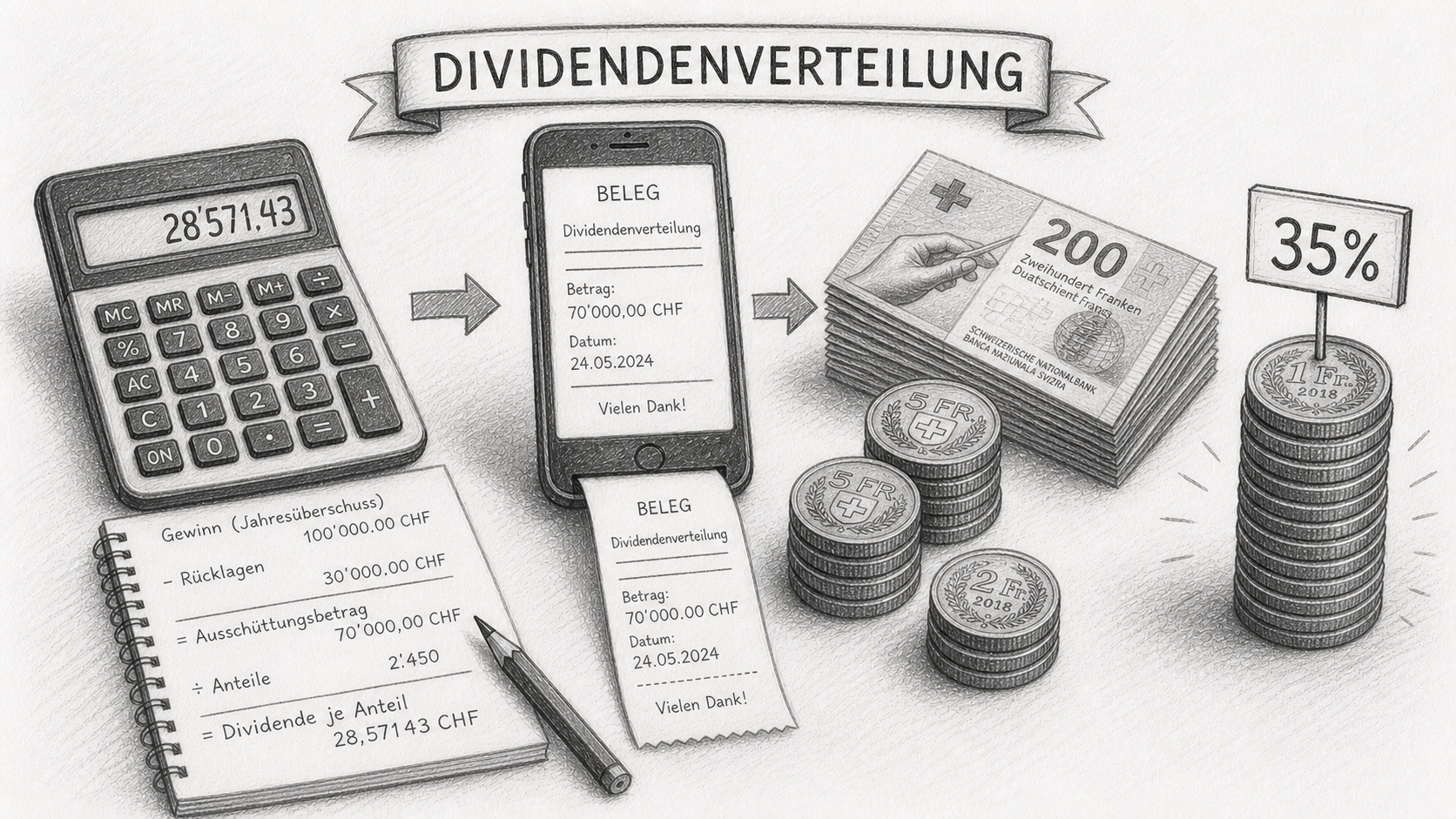
Dividend distribution begins with the annual financial statements and the board of directors’ proposal to the general meeting. This article explains the role of freely distributable funds, the statutory auditor and the general meeting resolution. It then shows how dividends are calculated and how withholding tax is handled. Finally, it outlines how Konsento supports the creation of dividend confirmations.
A dividend can be resolved quickly, but it is not always implemented properly. For a corporation to distribute a dividend lawfully, it first requires a permissible financial basis, followed by a proper proposal by the board of directors, a valid resolution by the general meeting, and finally a careful operational execution.
This article explains step by step how a dividend distribution in a Swiss corporation is carried out: from the annual financial statements and the dividend proposal to the general meeting, through to the distribution to entitled shareholders and the handling of withholding tax.
Table of Contents
- Annual financial statements as the basis for dividend distribution
- The dividend proposal of the board of directors
- Audit by the statutory auditor
- Resolution of the general meeting
- Operational dividend distribution
- Withholding tax: gross dividend, deduction and net dividend
- Conclusion
- How Konsento simplifies dividend processing
Annual Financial Statements as the Basis for Dividend Distribution
Every ordinary or extraordinary dividend distribution begins with the annual financial statements. As a rule, the latest annual accounts form the basis for deciding whether and to what extent a dividend can be distributed.
Swiss corporate law sets clear limits. Dividends may only be distributed from retained earnings and from reserves created for this purpose (Art. 675 para. 2 CO). In addition, dividends may only be determined after allocations to the statutory profit reserve and any voluntary profit reserves have been made (Art. 675 para. 3 CO).
For the board of directors, this means that before submitting a dividend proposal, it must be verified whether sufficient freely distributable funds are actually available. The decisive factor is not the desire to distribute a dividend, but the financial basis reflected in the balance sheet. If the company’s financial position has materially deteriorated since the balance sheet date, a dividend may not be resolved on the basis of outdated figures if this would affect restricted equity.
In practice, the following questions are particularly relevant:
- Does the company show retained earnings or freely distributable reserves?
- Have statutory and any voluntary reserve allocations been taken into account?
- Are there indications that the financial position has materially deteriorated since the balance sheet date?
- Should a distribution be made from the current financial year, requiring interim financial statements?
The annual financial statements are therefore not merely a formal attachment to the general meeting. They form the financial and legal basis for whether a dividend may be distributed at all.
The Dividend Proposal of the Board of Directors
Based on the annual financial statements, the board of directors submits a proposal to the general meeting regarding the appropriation of profits. It proposes whether a dividend should be distributed and in what amount. Only a dividend resolution of the general meeting that complies with statutory requirements forms the legal basis for shareholders’ dividend claims.
The proposal must remain within the limits of freely distributable funds. If non-distributable equity is distributed, the dividend resolution is null and void. The board of directors must therefore consider not only retained earnings but also restrictions, reserve requirements, and any interim dividends already distributed.
In practice, the general meeting may approve a maximum amount for the annual dividend and authorize the board of directors to distribute partial amounts over the course of the year. It may also defer the due date of the dividend or authorize the board to determine it. This is particularly relevant where dividends are paid in instalments.
Audit by the Statutory Auditor
If the company is subject to an ordinary or limited audit, the annual financial statements must be audited by the statutory auditor. The auditor also verifies whether the dividend proposal submitted by the board of directors complies with the law and the articles of association (Art. 728a para. 1 no. 2 CO and Art. 729a para. 1 no. 2 CO).
The auditor prepares a written report for the general meeting. Distributions not based on audited financial statements are unlawful. However, if the company has validly opted out of a limited audit, the obligation to audit both the financial statements and the dividend proposal no longer applies.
In the case of extraordinary dividends, the question may arise whether the latest annual financial statements still provide a sufficient basis. If interim financial statements are required, these must generally also be audited. Even if no interim statements are prepared, an up-to-date confirmation by the auditor may still be required to confirm compliance with the law and the articles of association.
Resolution of the General Meeting
The decision on dividend distribution lies with the general meeting. This power is non-transferable and inalienable (Art. 698 para. 2 no. 4 CO). The board of directors may prepare and propose the dividend, but cannot validly resolve it itself.
The resolution is adopted by the general quorum, i.e. an absolute majority of the votes represented, unless the articles of association provide otherwise (Art. 703 CO). A dividend resolved by any body other than the general meeting is null and void.
If the company is subject to an ordinary audit, the statutory auditor must generally be present at the general meeting. Otherwise, the dividend resolution may be challenged (Art. 731 para. 3 CO). Shareholders may unanimously waive the auditor’s presence (Art. 731 para. 2 CO). In companies with a limited audit, the auditor’s presence is not required.
With a valid dividend resolution, the shareholders’ entitlement to the dividend arises. As a rule, the dividend becomes due immediately upon the resolution of the general meeting. However, the general meeting may defer the due date or authorize the board of directors to determine it.
Operational Dividend Distribution
Following the resolution, the company must determine who is entitled to dividends and to what extent. Dividends are generally calculated in proportion to the paid-in share capital (Art. 661 CO). Share premium, unpaid share capital and treasury shares are not taken into account.
This principle may be modified by the articles of association, for example through preferential rights. In such cases, distribution is determined by the relevant statutory provisions rather than solely by paid-in capital.
Operationally, this means that the company must accurately determine the eligible holdings and calculate the distribution correctly. It is particularly important to assess whether instruments other than shares are involved. Withholding tax also applies to distributions to holders of participation certificates, as these are treated as equity participation rights.
Operational dividend distribution essentially consists of three steps:
- Identification of entitled persons and participation rights
- Calculation of the gross dividend according to the applicable allocation key
- Payment of the net dividend after deduction of withholding tax
Dividend claims become time-barred five years after they arise (Art. 128 no. 1 CO). For this reason as well, clear documentation of declared, calculated and paid dividends is essential.
Withholding Tax: Gross Dividend, Deduction and Net Dividend
When paying dividends, the company must generally deduct or withhold 35% of the dividend amount as withholding tax and remit it to the Swiss Federal Tax Administration (Art. 4 para. 1 lit. b WHTA, Art. 13 para. 1 lit. a WHTA, Art. 14 para. 1 WHTA).
The company, as debtor of the taxable benefit, is liable for the tax. However, the tax must mandatorily be passed on to the recipient (Art. 14 para. 1 WHTA). In practice, this means that the company calculates the gross dividend, deducts 35%, and pays the net dividend to the shareholder or participant.
Assuming the withholding tax on behalf of the recipient is not permitted. The recipient may reclaim or credit the withholding tax in accordance with the statutory provisions. In international group structures, the notification procedure may apply under certain conditions (Art. 20 WHTA).
Conclusion
Dividend distribution in a Swiss corporation follows a clear process. First, a permissible financial basis must exist in the annual financial statements. The board of directors then submits its dividend proposal to the general meeting. If the company is subject to audit, the statutory auditor verifies compliance with the law and the articles of association. The general meeting then resolves on the distribution.
With a valid resolution, shareholders’ entitlement to the dividend arises. The operational distribution requires accurate identification of entitled persons, proper calculation of the gross dividend, application of the relevant allocation rules, and deduction of withholding tax. Particularly in companies with multiple shareholders, participation certificates or special statutory rights, a structured process is essential.
How Konsento Simplifies Dividend Processing
Konsento supports Swiss SMEs in handling operational dividend distribution in a structured, efficient and transparent manner.
For the dividend resolution, Konsento’s general meeting module provides a template for the corresponding agenda item. Once the general meeting has resolved on the dividend, dividend confirmations can be generated for all entitled shareholders and participation holders.
The relevant record date forms the basis. Using the share register, Konsento automatically determines which persons are entitled to dividends at that date and with how many participation rights they must be considered. During the process, the relevant financial instruments are selected, the entitled investors are identified, and the gross dividend per share is recorded. Konsento then automatically deducts withholding tax and calculates both the net dividend and the total amount per holding.
This converts the core part of dividend processing into a clear digital workflow: from determining entitled holdings at the record date, to calculating the gross dividend per share, through to generating complete dividend confirmations including withholding tax and net dividend. All confirmations for all affected shareholders and participation holders can be created in just a few clicks.
This significantly reduces manual effort for companies while ensuring a clear and traceable basis for communication with entitled recipients.
Companies that want to not only resolve dividends correctly, but also process them efficiently and cleanly, benefit from a structured digital workflow.
Register now on Konsento and set up your company (AG) using a guided process so you can efficiently carry out your next dividend distribution.