
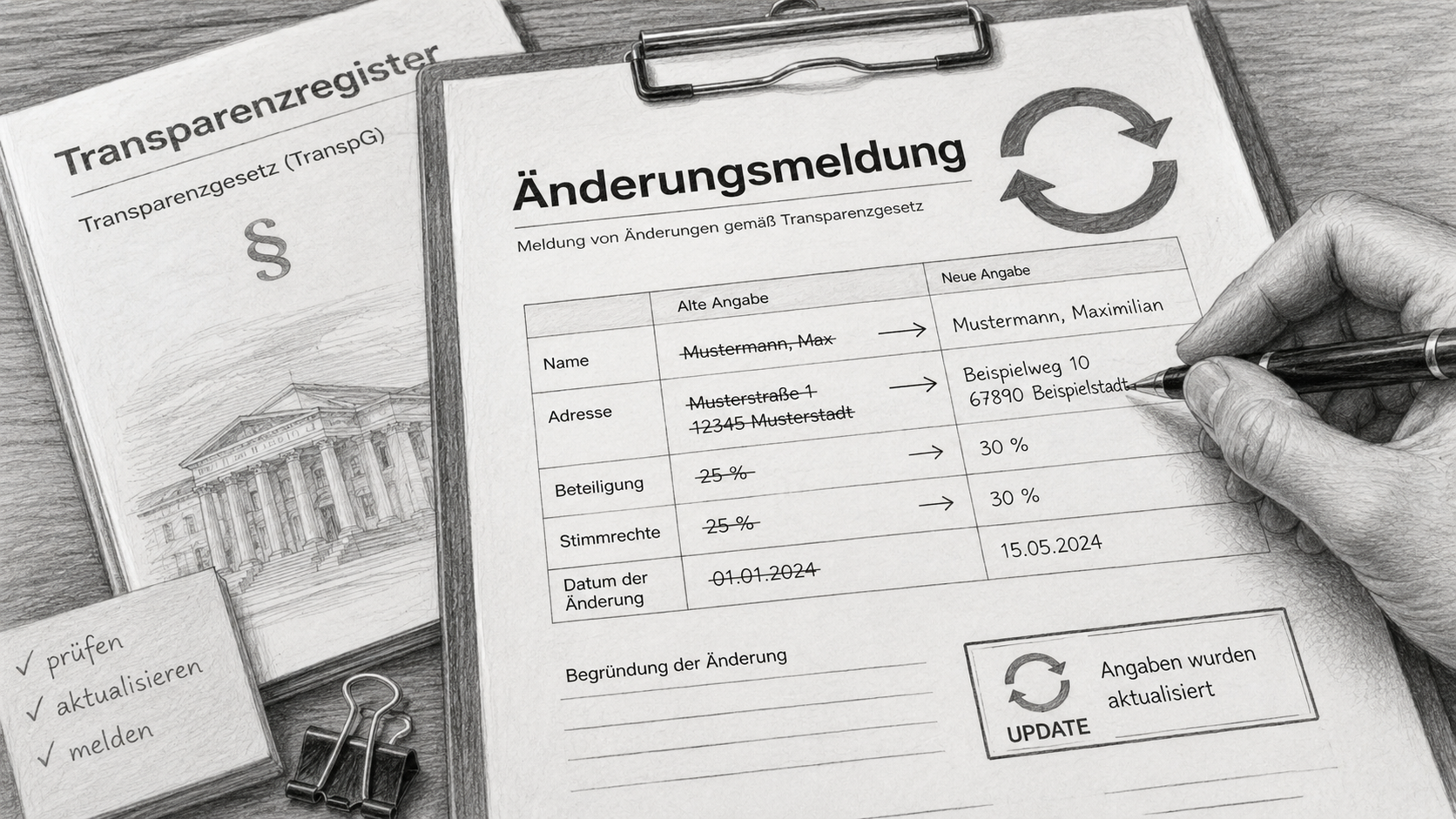
The Transparency Register only fulfils its purpose if entries are continuously updated. This article explains which changes are subject to the notification duty, how the procedure via the electronic platform works, and which situations are exceptionally exempt from the notification duty. It also shows why the company needs an internal control system in order to reliably comply with the one-month deadline under Art. 10 LETA. Responsibility remains with the most senior member of the managing body under Art. 12 LETA, who must arrange for the notifications even where they are delegated internally or externally.
With the Federal Act on the Transparency of Legal Entities and the Identification of Beneficial Owners (LETA), the Transparency Register moves to the centre of corporate compliance for many Swiss stock corporations. Most current discussions revolve around the initial notification. Yet what comes after is at least equally decisive. The register only fulfils its purpose if the information once reported also remains up to date.
This is precisely where the duty to notify changes comes in. The company must report any change to a fact recorded in the Transparency Register within one month of becoming aware of it (Art. 10 LETA). This article answers the central question of which changes are typically subject to the notification duty, how the reporting procedure works, when a notification is exceptionally not required, and which organisational measures are needed so that the one-month deadline does not pass unnoticed in day-to-day operations.
Table of Contents
- Why ongoing updates matter
- What qualifies as a reportable change
- Typical change scenarios from corporate practice
- When the notification duty is exceptionally waived
- Why the company needs an internal control system
- Sanctions for missed change notifications
- Conclusion
Why ongoing updates matter
The Transparency Register is designed as a central register so that authorities can quickly access correct, complete and current information on beneficial owners. This currency is meant to exist not only at the moment of initial notification, but on a permanent basis. To make this work, the law obliges the company to keep the reported information continuously up to date (Art. 10 LETA).
Three guiding principles are central here. First, the one-month deadline is not tied to the date of the change itself, but to the company's knowledge. The deadline therefore only starts to run once the information has reached the company (Art. 10 LETA). Second, within the company a clearly designated person bears the responsibility: the most senior member of the managing body must arrange for the notifications. Delegation within the company or to external service providers is permitted, but the responsibility remains with the most senior body in any case (Art. 12 LETA). Third, the ordinance specifies the procedure for change notifications. Changes are generally submitted via the electronic platform, which loads the existing register entry as an input aid (Art. 18 para. 1 and 2 LETO).
What qualifies as a reportable change
The wording of the law is deliberately broad. Any change to a fact that is recorded in the Transparency Register is subject to the notification duty (Art. 10 LETA). The duty therefore essentially covers three categories of information, namely information about the company itself, information about the reported persons, and information about the nature and extent of control.
For the company, this concerns identification and contact data such as business name, registered office or domicile. For the reported persons, this concerns the beneficial owners and, where applicable, further persons to be reported, with details such as name, address and nationality. For the control relationships, the question is finally how control is exercised, for example via shareholding thresholds or "by other means". The ordinance picks up this structure by basing change notifications on the existing register entry and using it as the starting point for the update (Art. 18 para. 2 LETO).
Typical change scenarios from corporate practice
In practice, the reportable situations fall into three thematic areas, each of which carries its own pitfalls.
Changes in ownership and control
Changes in ownership and control relationships are the most frequent and at the same time the most sensitive area of application. Not every minor shift automatically triggers a notification duty. The ordinance contains an important restriction: a change in a participation only needs to be reported if it causes a threshold to be exceeded or fallen below (Art. 18 para. 3 LETO).
This rule noticeably reduces the reporting burden, but at the same time it requires the company to reliably keep track of the relevant thresholds. In practice, movements around 25 % and 50 % are particularly relevant, for example a shift from a participation just below 25 % to one above 25 %, or the other way round. Whether control is exercised through capital, voting rights or "by other means" is not a theoretical detail. It can determine on a case-by-case basis whether a notification duty is triggered or not.
Changes regarding already reported persons
If the master data of a beneficial owner already reported changes, the register entry is no longer up to date. Such changes are generally subject to the notification duty (Art. 10 LETA). Typical situations from daily practice include a change of name, for example following marriage, a change of residence, a change of nationality, or a change in the configuration of beneficial ownership itself, for example when a person falls below a shareholding or control threshold. The ordinance provides for practically relevant simplifications for some of these cases, which are addressed in the following section.
Changes concerning the company itself
Information about the company can also change. Here, however, it must be carefully distinguished whether the information is already captured by another Swiss register or whether the company must actively report it to the Transparency Register. The ordinance provides, for example, that changes to the business name that are recorded in the Commercial Register cause the notification duty under Art. 10 LETA to lapse (Art. 18 para. 4 lit. a LETO). This distinction shows how important it is to have a clear picture of which information flows automatically "via the register" and which must be actively reported.
When the notification duty is exceptionally waived
The ordinance sets out several situations in which the duty to notify changes to the Transparency Register does not apply. The underlying logic is consistent. Where a change is already reliably captured by other Swiss administrative registers, no duplicate reporting layer should arise.
Specifically, the notification duty under Art. 10 LETA does not apply in particular in the following cases:
- Changes to the business name recorded in the Commercial Register (Art. 18 para. 4 lit. a LETO)
- Changes of name declared in Switzerland via the Civil Registry Office and thus officially recorded (Art. 18 para. 4 lit. b LETO)
- Changes of name under foreign law, provided that they have been reported to Swiss authorities for entry in ZEMIS (Art. 18 para. 4 lit. c LETO)
- Changes of Swiss citizenship (Art. 18 para. 4 lit. d LETO)
- Changes of foreign nationalities, provided that they have been reported in Switzerland to the Civil Status Register or to ZEMIS (Art. 18 para. 4 lit. e LETO)
It is important to note that these exemptions are closely tied to the idea of a change "already reported to the authorities". They do not replace internal monitoring; they merely avoid duplications where the conditions are actually met. The responsibility for ensuring that such an exemption applies in the specific case lies with the company.
Why the company needs an internal control system
The one-month deadline under Art. 10 LETA presupposes that the company recognises a relevant change in good time. This is not something that happens by itself. Information about changes in shareholdings, persons or control relationships rarely reaches the responsible function within the company on its own. For precisely this reason, the law builds on cooperation duties in the company's environment. Shareholders and quotaholders must report changes in the relevant information to the company within one month (Art. 13 para. 5 LETA).
This cooperation duty does not, however, relieve the company. The responsibility for the notification itself remains with the most senior member of the managing body. It cannot be discharged by pointing out that someone else within the company was responsible (Art. 12 LETA). Anyone wishing to live up to this responsibility in everyday practice needs an organisational structure that makes changes visible at an early stage. Four organisational minimum standards have proven their worth.
- A clear allocation of responsibility for Transparency Register compliance, both at board level and in the operational area
- Recurring reconciliations between the share register or the register of quotas and the data in the Transparency Register
- Clearly defined triggers for reviewing the notification duty, such as capital increases, share transfers, changes to pooling or syndicate agreements, and adjustments to voting rights commitments
- A documented escalation process as soon as it becomes apparent that a threshold is being exceeded or fallen below, or that a relevant change in persons is occurring
The first point in particular shows how closely the topics of share register management and the Transparency Register are intertwined. Anyone keeping the share register in unstructured Excel or Word files will find it considerably harder to detect threshold movements in time. A structured digital share register – as offered by Konsento for non-listed stock corporations – provides the foundation here, because shareholding relationships are transparent, audit-proof and traceable in real time at any moment. Transparency Register monitoring thus does not become an isolated additional project, but is embedded in the existing governance process.
Sanctions for missed change notifications
Missed change notifications are not merely a compliance shortfall, but a punishable breach of duty. Violations of the notification and information duties may be sanctioned with a fine of up to CHF 500,000, with the breach of the duty to notify the Transparency Register or the Commercial Register under Art. 9–11 LETA being expressly covered (Art. 43 LETA). Missed change notifications under Art. 10 LETA therefore fall within the risk perimeter. In practice, the risk of fines is not the only aspect. There are also reputational risks vis-à-vis banks, investors and business partners, who, as part of their own due diligence duties, will increasingly pay attention to the consistency of register entries.
Conclusion
Change notifications are the central instrument for keeping entries in the Transparency Register permanently up to date. The company must report any change to a recorded fact within one month of becoming aware of it (Art. 10 LETA). The ordinance specifies the procedure via the electronic platform and limits the notification duty in the case of changes in participation to the actual threshold movement (Art. 18 para. 1–3 LETO). For a number of situations in which the information already flows via other Swiss administrative registers, the notification duty is waived (Art. 18 para. 4 LETO).
Decisively, this regime only works reliably if the company internally recognises what is changing. This requires clear responsibilities, regular reconciliations, and clean share register management as the underlying data foundation. Responsibility remains with the most senior member of the managing body (Art. 12 LETA), regardless of whether operational implementation takes place internally or externally.
Stay informed
If you would like to receive regular and straight-to-the-point information on the duties relating to the Transparency Register, subscribing to our newsletter is worthwhile. Short, factual and focused on what really matters in everyday practice.