
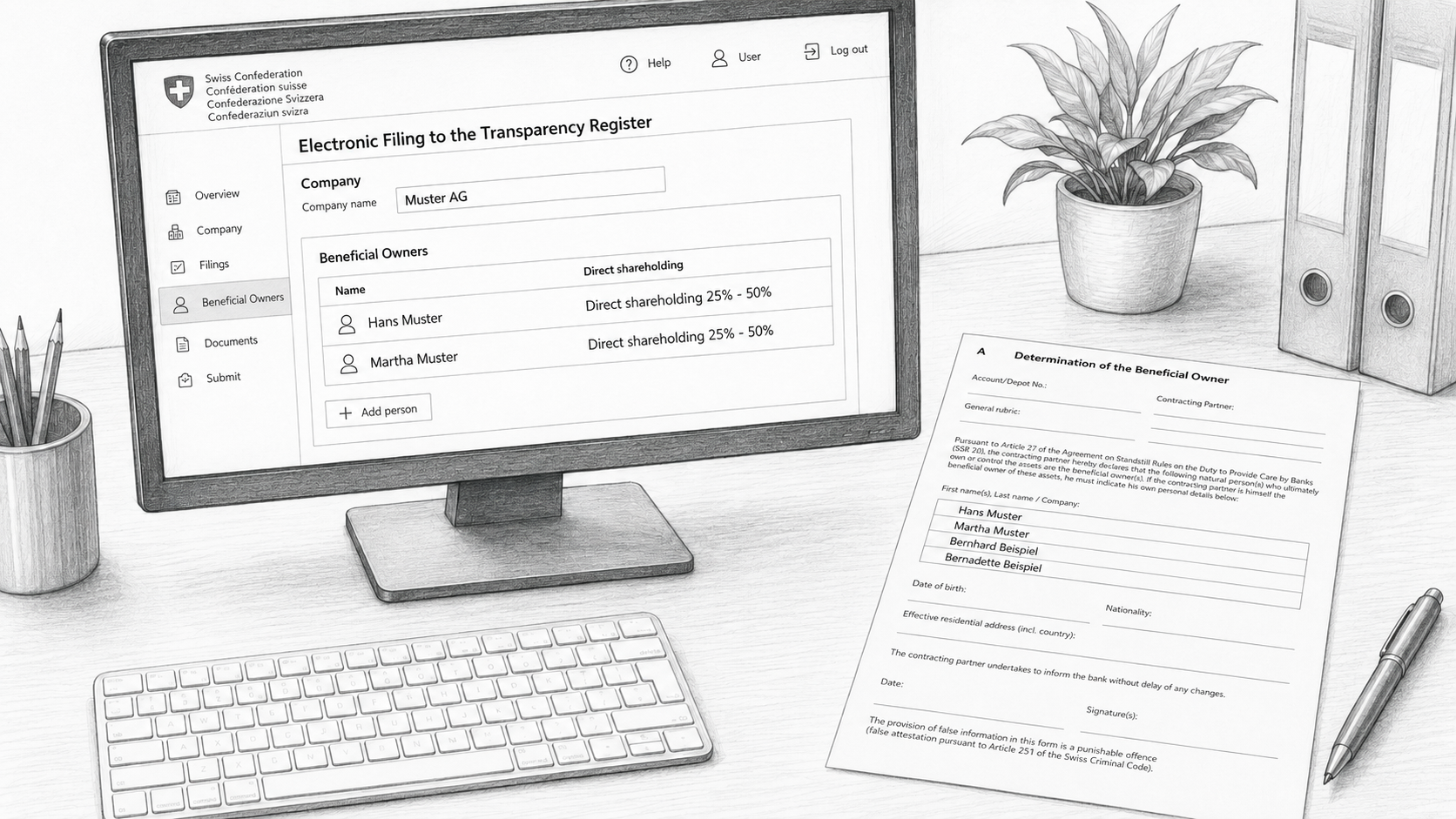
For domiciliary companies, the CDB 20 and the Transparency Act determine the beneficial owner according to different standards. Under the CDB 20, the bank captures on Form A all persons to whom the assets economically belong, irrespective of the size of the holding. The Transparency Act, by contrast, applies the 25 percent threshold under Art. 4 LETA uniformly to all companies. The article explains why this can give rise to differences between the bank file and the Transparency Register and how the Ordinance on the Transparency of Legal Entities exempts these cases from the notification obligation. It also shows what boards of directors should bear in mind in practice.
Many entrepreneurs are familiar with the identification of the controlling person or the beneficial owner from the account-opening conversation with their bank. The bank wants to know who stands behind the company and has this confirmed in writing by means of Form K or Form A. With the Transparency Act (LETA), which enters into force on 1 October 2026, a second, similar obligation is added. Going forward, the beneficial owners of a company must also be entered in the federal Transparency Register. At first glance, both obligations look like the same thing in different packaging. On closer inspection, however, one finds that the bank and the register do not always regard the same persons as beneficial owners. This is particularly evident in the case of so-called domiciliary companies.
This article explains in simple terms what a domiciliary company is, why your own bank may in certain circumstances record different persons as beneficial owners than the Transparency Register does, and why this is no cause for concern.
Contents
What is a domiciliary company?
How does the bank identify the beneficial owner of a domiciliary company?
How does the Transparency Act determine the beneficial owner?
What are the consequences in practice?
How does the Ordinance resolve this tension?
What does this mean in concrete terms for boards of directors and companies?
The next step for your company
For banks and financial intermediaries
What is a domiciliary company?
The concept of the domiciliary company does not stem from the Transparency Act, but from the banks' code of conduct with regard to the exercise of due diligence, CDB 20 for short. A domiciliary company is any Swiss or foreign legal entity, company, establishment, foundation, trust, fiduciary enterprise or similar association that is not operationally active (Art. 39 para. 2 CDB 20). Two indications point to a domiciliary company. Either it has no business premises of its own, for instance because the company is domiciled with a lawyer, a fiduciary company or a bank and holds a c/o address there, or it employs no staff of its own (Art. 39 para. 3 CDB 20).
For that reason, not every company without staff of its own automatically qualifies as a domiciliary company. Associations and similar groupings that pursue exclusively non-material aims such as mutual self-help do not fall within the definition (Art. 39 para. 4 let. a CDB 20). The same applies to holding companies that predominantly hold operating companies, provided their purpose does not consist mainly in managing the assets of third parties (Art. 39 para. 4 let. b CDB 20). The Swiss Bankers Association's commentary on the CDB 20 illustrates this distinction with an example. A holding company at the head of a trading or manufacturing group is treated like an operating company, even if it employs no staff of its own. If, by contrast, the same structure merely pools the assets of a family or serves only to enable distributions to shareholders, it qualifies as a domiciliary company.
According to the logic of the CDB, a company that is not operationally active does not hold the assets in its bank account for itself, since it has no need to use them to purchase raw materials, pay wages or finance other production costs, but instead holds those assets directly for third parties, who must be documented on Form A.
For banks, this classification is more than a formality. Domiciliary companies without operational substance of their own are regarded, because of the absence of any verifiable business activity, as a constellation with an increased money laundering risk.
How does the bank identify the beneficial owner of a domiciliary company?
In the case of a domiciliary company, the bank requires the contracting partner to provide a declaration by means of Form A as to who is the beneficial owner of the assets held in the bank account or the securities deposit (Art. 39 para. 1 CDB 20). This form follows the general rule that, as a matter of principle, natural persons are to be identified as beneficial owners (Art. 27 para. 1 and 2 CDB 20). This rule knows no fixed participation threshold. The only decisive factor is to whom the assets economically belong, regardless of how large the individual holding is. The declaration on Form A therefore relates not to the ownership structure of the domiciliary company, but to that of the assets in the account. For this purpose, the bank records the surname, first name, date of birth, nationality and residential address of each beneficial owner (Art. 28 para. 1 CDB 20).
For operating companies, the process is different. There, the familiar pattern with Form K applies. Controlling persons are those who hold 25 percent or more of the capital or the voting rights (Art. 20 para. 1 CDB 20). If no such holding exists, their place is taken by whoever exercises control in another identifiable manner, and if that too cannot be established, the managing person qualifies as the controlling person by way of substitution (Art. 20 para. 3 and 4 CDB 20). Beyond this, non-listed operating companies must provide an additional declaration on the beneficial ownership of the assets only if they declare that they hold these assets for a specific third party (Art. 30 CDB 20).
The difference between the two forms is therefore not merely administrative in nature. Form K asks about control over the company and applies a threshold of 25 percent. Form A asks to whom the assets economically belong and applies no such threshold. Because a domiciliary company is, as a rule, captured through Form A, the bank documents there all persons who are beneficial owners of the assets, even where an individual share lies well below 25 percent.
How does the Transparency Act determine the beneficial owner?
The Transparency Act proceeds differently from the CDB 20. The beneficial owner of a company is any natural person who controls it, directly or indirectly, alone or together with others, with at least 25 percent of the capital or the votes, or who controls it in another manner (Art. 4 para. 1 LETA). If no one can be determined in this way, the most senior member of the executive management takes this place by way of substitution (Art. 4 para. 2 LETA).
This rule applies to every company alike, entirely irrespective of whether it is operationally active or qualifies as a domiciliary company under the CDB 20. The legislator deliberately decided against adopting the distinction known to anti-money laundering law and the CDB 20, and applies the 25 percent threshold equally to all entities within its scope (Dispatch of 22 May 2024, BBl 2024 1607, p. 131).
What are the consequences in practice?
In practice, these differing approaches lead to a familiar picture. A family holding company that merely pools the assets of a family qualifies as a domiciliary company at the bank and must therefore list all family members as beneficial owners on Form A, irrespective of the size of their holding (Art. 39 para. 1 CDB 20 in conjunction with Art. 27 CDB 20). If the same company reports its beneficial owners to the Transparency Register, only those family members who hold at least 25 percent of the capital or the votes or who control the company in another manner count there (Art. 4 para. 1 LETA). Anyone registered as a beneficial owner at the bank with a smaller share need not necessarily appear in the Transparency Register.
Where, in the case of a domiciliary company, a bank records all shareholders as beneficial owners of the assets on Form A, it need not file a notification merely because persons with a holding of less than 25 percent are absent from the Transparency Register (Dispatch of 22 May 2024, BBl 2024 1607, p. 131).
Without a clear rule, this situation could have led to a considerable number of superfluous notifications. Financial intermediaries must, after all, report a discrepancy between their own information and the Transparency Register where it gives rise to justified doubts about the accuracy, completeness or currency of the register entries and persists despite the setting of a deadline for the client (Art. 30 para. 1 LETA). The notification must be filed within 30 days (Art. 30 para. 2 LETA), and the same obligation also applies to authorities (Art. 31 LETA). In the consultation on the Transparency Ordinance in January 2026, the Swiss Bankers Association pointed out that the exception provision initially proposed was drafted too narrowly to reflect appropriately the special treatment of domiciliary companies under the CDB 20, which, without clarification, would have led to a large number of unnecessary notifications.
How does the Ordinance resolve this tension?
The Ordinance on the Transparency of Legal Entities takes up this criticism. Discrepancies need not be reported where they arise from diverging provisions of anti-money laundering legislation, in particular from the definition of the beneficial owner of a domiciliary company, or because financial intermediaries are not obliged under that legislation to identify all beneficial owners within the meaning of the Transparency Act (Art. 56 let. a LETO). The explanatory report on the Ordinance thereby expressly confirms that a bank which, on the basis of the CDB 20, records additional or different persons as beneficial owners of a domiciliary company need not file a notification where those persons are not captured by Art. 4 LETA.
This exception concerns solely the notification obligation towards the Transparency Register. It changes nothing about the bank's own due diligence obligations. These continue to derive exclusively from the Anti-Money Laundering Act and the CDB 20 and are neither extended nor restricted by the entry into force of the Transparency Act. Equally, nothing changes about the obligation of the company itself to determine its beneficial owners according to the uniform standard of Art. 4 LETA and to report them to the Transparency Register.
For trusts, the exception applies only to a limited extent. Because the information under Form T must also be reported to the Transparency Register (Art. 15 LETA), the logic provided for domiciliary companies cannot readily be transferred to trust structures. Anyone running a company with a trust in the control chain should examine this point separately.
What does this mean in concrete terms for boards of directors and companies?
Nothing changes about the company's own notification obligation. The decisive factor in every case remains the uniform standard of Art. 4 LETA, regardless of whether the company itself qualifies as a domiciliary company or as an operating company under the CDB 20.
Those who sit on the board of directors should not, however, be surprised if their own bank records more persons, or different persons, as beneficial owners on Form A than later appear in the Transparency Register. This is neither an error nor negligence on the bank's part, but the consequence provided for by law of two sets of rules with different objectives. If the bank makes contact over a supposed discrepancy, it is worth first examining whether it does not already fall under one of the exceptions in Art. 56 LETO before a correction of the register entry is considered.
Conclusion
The CDB 20 and the Transparency Act pursue different approaches to determining the beneficial owner of domiciliary companies. Whereas the bank captures on Form A all persons to whom the assets economically belong, irrespective of the size of the holding (Art. 39 and 27 CDB 20), under Art. 4 LETA the 25 percent threshold applies uniformly to all companies. The resulting differences between the bank file and the Transparency Register are intended and, following corresponding feedback from the consultation, were expressly exempted from the notification obligation (Art. 56 let. a LETO). For companies, this means above all one thing. Their own report to the Transparency Register always follows the uniform standard of Art. 4 LETA, regardless of what the bank documents on its own Form A.
The next step for your company
To identify your own beneficial owners and prepare the report to the Transparency Register, Konsento offers the LETA Reporting Tool. The guided assistant asks, in plain language, precisely those questions that the law requires, with no prior legal knowledge needed. The process runs through six phases, from identifying the company and a preliminary check for straightforward cases to the full identification of the beneficial owners, including control chains, trusts and foundations where relevant, followed by a plausibility check and a preview of the complete report content. In doing so, the tool automatically applies all the rules under Art. 1 to 7 LETO, from the 25 percent threshold to the special rules for trusts and Swiss foundations.
At the end, alongside the ready-to-file dataset, an internal documentation dossier is also available that records the entire identification process without gaps, supplemented by an automatically generated control-chain graphic, an integrated sanctions check and a structured CSV export. Because later changes in the ownership situation must likewise be filed as a discrepancy notification within 30 days, the tool is designed for recurring use and not only for the initial report. It is available to reporting companies from the start of the notification obligation on 1 October 2026.
Companies subject to the notification obligation can, however, already prepare for the report to the Transparency Register now, by mapping their share register electronically in structured, legally compliant and exportable form in Konsento's share register. This is free of charge for up to 150 shareholders.