
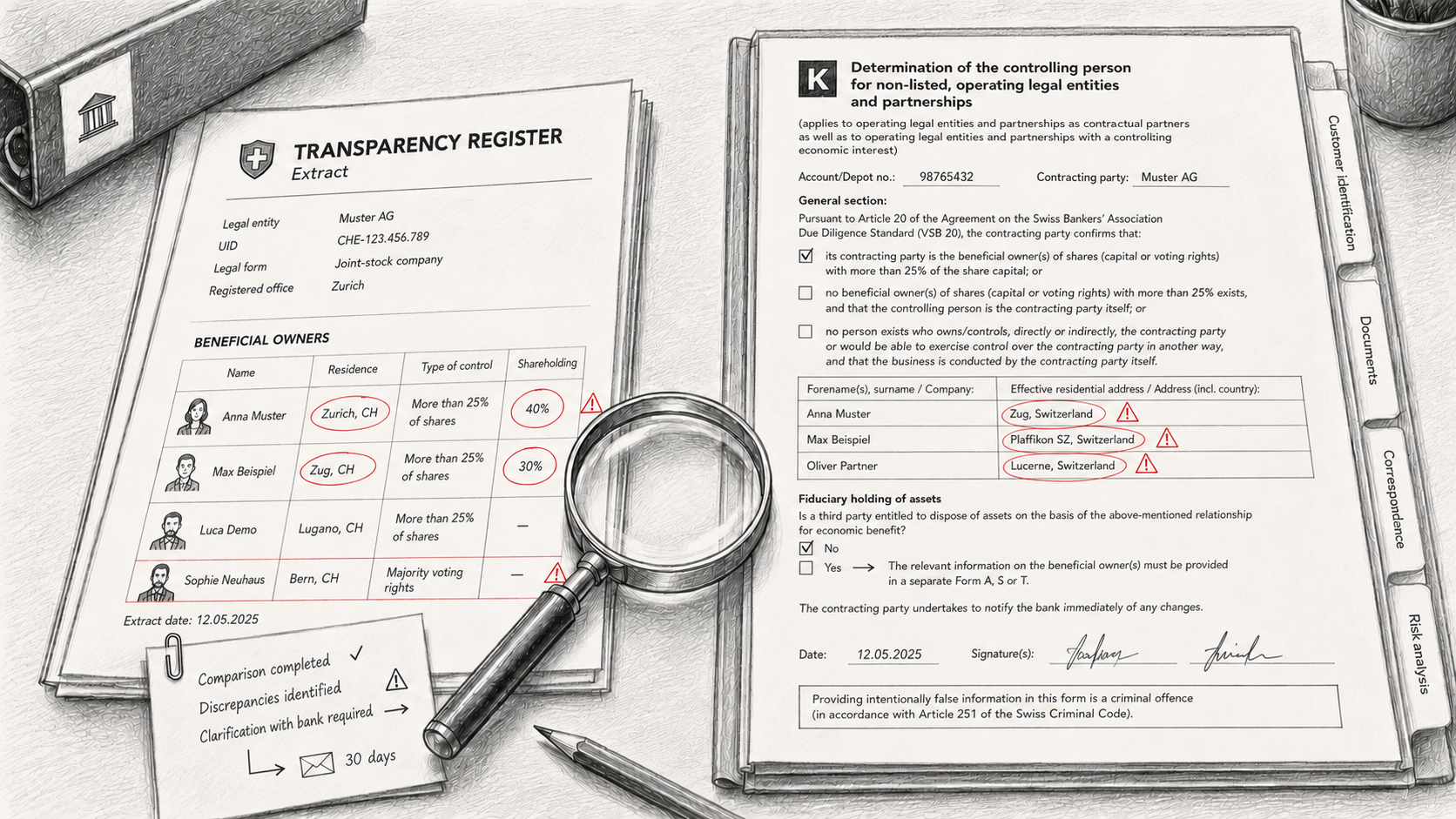
The LETA grants banks, financial intermediaries and advisers the right to retrieve data from the Transparency Register to the extent necessary for the fulfilment of their AMLA due diligence obligations. The Act does not create a new self-standing query obligation, but existing AMLA due diligence obligations may in practice make consulting the register necessary. Where financial intermediaries identify discrepancies that give rise to doubts about the accuracy of the register information, they must follow a two-step procedure: first an informal clarification with the client, then, if necessary, a formal discrepancy notification within 30 days. The notification is standardised in content and provides for an exhaustive catalogue of grounds. Certain discrepancies are expressly excluded from the notification obligation, including discrepancies arising from divergent definitions under anti-money laundering law.
The Swiss Federal Act on the Transparency of Legal Entities and the Identification of Beneficial Owners (Transparency Act, LETA) does not only impose obligations on companies required to report their beneficial owners. It also governs who may access data from the Transparency Register under what conditions – and what happens when that data diverges from a financial intermediary’s own records. For banks, financial intermediaries and advisers, this creates a clearly defined but demanding regime: a right of access, a logging obligation, a discrepancy notification procedure and – in the event of non-compliance – consequences. This article explains how the framework operates and what the stakeholders concerned can expect in practice.
Table of Contents
• Who has access to the Transparency Register and for what purpose?
• The right of access – or a new obligation after all?
• What can be searched – and what cannot?
• Logging and purpose conformity: every query leaves a trace
• Discrepancy notifications by financial intermediaries: procedure and deadline
• Content of the notification and obligation to state reasons
• Exceptions to the notification obligation
• Conclusion
• FAQ
Who has access to the Transparency Register and for what purpose?
The LETA distinguishes between public authorities and private-law actors with respect to access to the Transparency Register. Authorities such as police, criminal prosecution and administrative authorities, the Money Laundering Reporting Office and tax authorities have comprehensive online access under certain conditions (Art. 26 LETA).
Banks, financial intermediaries and advisers are subject to a separate, purpose-limited regime (Art. 27 LETA). Access to the Transparency Register is granted to financial intermediaries within the meaning of Art. 2 para. 2 and 3 of the Anti-Money Laundering Act (AMLA) and to advisers within the meaning of Art. 2 para. 3bis and 3ter AMLA. This includes banks and securities dealers as well as asset managers, fund management companies, insurance institutions and other financial service providers, as well as lawyers, notaries and trustees insofar as they are subject to the AMLA in the course of their business activities.
The purpose of access is narrowly defined by statute: financial intermediaries and advisers may only retrieve data from the Transparency Register to the extent necessary for the fulfilment of their due diligence obligations under the AMLA, and they may use that data exclusively for that purpose (Art. 27 LETA). Data deleted pursuant to Art. 24 LETA and the identity of the originators of discrepancy notifications are not retrievable – anyone who has reported a discrepancy to the register therefore remains anonymous to querying financial intermediaries (Art. 27 LETA).
The right of access – or a new obligation after all?
Art. 27 LETA confers a right of online retrieval on banks, financial intermediaries and advisers – not an obligation. The Federal Council states explicitly in the explanatory report on the LETO that the obligation to notify discrepancies (Art. 30 LETA) does not require financial intermediaries to systematically reconcile client data against the register or to query the register on a comprehensive basis. The due diligence obligations of banks and financial intermediaries derive from anti-money laundering legislation and are neither amended nor extended nor restricted by the entry into force of the LETA.
That statement is accurate – and it is also easily misread. The LETA does not create a new, self-standing query obligation. It does, however, create a new, officially maintained and readily accessible source of information on beneficial owners. And that is not without consequences for the existing due diligence obligations of financial intermediaries.
Banks and financial intermediaries are required under the AMLA (in particular Art. 3 et seq. and Art. 6), the FINMA Anti-Money Laundering Ordinance (AMLO-FINMA), the Agreement on the Swiss banks’ code of conduct with regard to the exercise of due diligence (CDB) and criminal law (Art. 305ter, Art. 305bis and Art. 260ter of the Swiss Criminal Code; in the event of organisational deficiencies also Art. 102 SCC) to identify their clients and the beneficial owners, to investigate backgrounds and to respond to indications of elevated risk. A financial intermediary who fails, in the performance of these obligations, to consult an available and relevant source of information runs the risk of being found to have failed its due diligence obligations. Whether a query is appropriate in a specific case is therefore determined not by the LETA but by the standards that anti-money laundering law already prescribes.
There is also a practical aspect addressed separately in a dedicated blog post on shell companies under the LETA: for certain types of legal entities, in particular shell companies, the concept of beneficial owner differs between anti-money laundering law and the LETA. This creates interpretive scope but also a need to reconcile the financial intermediary’s own records with the register entries. In this context, the right of banks and financial intermediaries to query the register is less a supervisory obligation and more a genuine right.
What can be searched – and what cannot?
Banks, financial intermediaries and advisers may search the Transparency Register for legal entities by company name or name and by UID (Art. 48 para. 3 LETO). This allows them to retrieve the information recorded in the register on the beneficial owners of a specific legal entity with which they have an existing or prospective business relationship.
Searching by natural persons – i.e. querying for which legal entities a specific individual is recorded as beneficial owner – is available exclusively to authorities under Art. 26 LETA (Art. 48 para. 3 LETO). This type of search is not available to financial intermediaries and advisers. That is intentional: their starting point is always the specific client relationship in the context of which they need to identify or verify the beneficial owners of a particular legal entity. A search by legal entity is sufficient for that purpose.
Data deleted pursuant to Art. 24 LETA and – as noted above – the identity of the originators of discrepancy notifications are also not accessible. The scope of data retrieval by financial intermediaries is thus clearly bounded: access to the legal entity and to the beneficial owners recorded for that entity, nothing beyond.
Logging and purpose conformity: every query leaves a trace
Anyone who queries the Transparency Register automatically leaves a trace. Every query and every submission of information to the register is logged automatically by the register-keeping authority (Art. 53 para. 1 LETO; Art. 29 para. 2 LETA). The log records the designation of the authorised institution, the date and time of access, whether access was made via the electronic platform or an interface, whether information was queried or submitted, and which information was specifically retrieved (Art. 53 para. 1 lit. a–e LETO). Logs are retained for two years and then destroyed (Art. 53 para. 2 LETO). They are accessible exclusively to the register-keeping authority and do not form part of the content of the Transparency Register.
Authorised users may request a confirmation for each query made via the electronic platform. This contains the designation of the institution, date and time, and the company name and UID of the queried legal entity – but not the other information displayed during the query (Art. 53 para. 3 LETO).
Logging serves the purpose of monitoring purpose conformity. The register-keeping authority regularly evaluates the frequency and nature of access by authorised users and informs them of the results (Art. 54 para. 1 LETO). Where non-compliant use is suspected, it notifies the institution and warns of access suspension; the institution must then conduct internal investigations and report on the outcome (Art. 54 para. 2 LETO).
A query by an employee of a bank, financial intermediary or adviser that has no direct connection to the fulfilment of AMLA due diligence obligations is deemed non-compliant in particular (Art. 54 para. 3 LETO). In concrete terms, this means that queries may only be made in the context of existing or prospective business relationships for which a due diligence obligation exists under the AMLA. Indications of misuse may include a comparatively high query frequency, unusual query patterns or repeated queries concerning the same legal entity (Art. 54 para. 3 LETO). Where misuse is established, the register-keeping authority may suspend the access of the employee concerned at the bank, financial intermediary or adviser (Art. 54 para. 5 LETO).
A special rule applies to lawyers and notaries acting as advisers: where a query is made in the context of a mandate subject to professional secrecy, the register-keeping authority may neither request the name of the represented person nor require reasons for the query, to the extent covered by professional secrecy (Art. 54 para. 4 LETO).
Discrepancy notifications by financial intermediaries: procedure and deadline
The LETA obliges banks and financial intermediaries within the meaning of Art. 2 para. 2 and 3 AMLA to notify the Transparency Register of discrepancies between the register data and their own records under certain conditions (Art. 30 para. 1 LETA). Importantly: advisers under Art. 2 para. 3bis and 3ter AMLA – including lawyers, notaries and trustees – are expressly excluded from this notification obligation. They have the right to access the register but are not required to notify discrepancies.
The notification obligation applies to banks and financial intermediaries when two conditions are cumulatively met: first, the discrepancy identified must give rise to doubts as to the accuracy, completeness or currency of the information on the beneficial owner of a legal entity (Art. 30 para. 1 lit. a LETA); second, the discrepancy must persist after the client has been informed and given a reasonable period to rectify it, in particular by submitting a correction to the register (Art. 30 para. 1 lit. b LETA).
Notification procedure
The procedure thus unfolds in two steps. In the first step, the financial intermediary contacts the client directly, draws attention to the discrepancy and gives the client the opportunity to correct the register information or explain the divergence. If the client responds and is able to resolve the discrepancy or explain it conclusively, the notification obligation falls away. Only if the uncertainty persists after this informal clarification does the second step apply: the formal notification to the Transparency Register.
Notification deadline
The deadline for this notification is 30 days (Art. 30 para. 2 LETA). The start of the deadline is governed by Art. 57 LETO and depends on how communication with the client unfolds. The explanatory report on the LETO distinguishes three scenarios: if the client responds and resolves the discrepancy or explains it conclusively, the notification obligation falls away and the deadline does not begin to run at all. If the client responds within the time allowed but the discrepancy cannot be resolved – for example because the response is contradictory – the 30-day notification period begins upon receipt of that response (Art. 57 lit. b LETO). If the client does not respond at all, the period begins when the clarification deadline set for the client expires without a response (Art. 57 lit. a LETO).
A financial intermediary who notifies a discrepancy in good faith pursuant to these provisions cannot be held liable for any breach of official, professional or business secrecy, nor for any contractual breach (Art. 30 para. 4 LETA). This liability exemption is significant in practice: it removes the legal risk from filing a notification and strengthens the willingness to notify in cases of doubt.
An important transitional provision applies in the period immediately following entry into force of the Act: the obligation to notify discrepancies does not take effect until six months after the LETA enters into force (Art. 54 para. 1 of the LETA transitional provisions). If a financial intermediary discovers during the transitional period that a legal entity is not registered at all, it must first enquire whether the entity is relying on the two-year registration transitional period. If confirmed, no notification obligation arises until that period expires (Art. 54 para. 2 of the LETA transitional provisions).
Content of the notification and obligation to state reasons
The notification must be made in standardised form and must meet a minimum statutory content requirement (Art. 30 para. 3 LETA; Art. 55 para. 1 LETO). It must include the date of notification, the designation of the notifying institution, the company name or name as well as the registered office and UID of the affected legal entity, and a statement of the respect in which the discrepancy exists or that a register entry is missing.
In addition, Art. 55 para. 2 LETO requires a statement of reasons drawn from an exhaustive catalogue. The financial intermediary must specify which of the following grounds applies to its case:
- One or more beneficial owners identified by the financial intermediary are not registered.
- One or more persons are registered despite not being beneficial owners or persons providing information under Art. 21 para. 1 lit. b LETO.
- A person was notified subsidiarily as a beneficial owner or as a person providing information under Art. 21 para. 1 lit. b LETO, even though one or more beneficial owners are in fact known.
- The type of control exercised by one or more beneficial owners is not correctly registered.
- The extent of control exercised by one or more beneficial owners is not correctly registered.
- The particulars of one or more beneficial owners or of a person providing information are inaccurate or incomplete.
- The particulars of the legal entity itself are inaccurate or incomplete.
- The entry of the legal entity in the Transparency Register is entirely missing.
Beyond these standardised grounds, financial intermediaries may submit additional information, supporting documents and annexes to explain the notification (Art. 55 para. 3 LETO; Art. 30 para. 3 LETA). This may include documentation relating to the person whom the financial intermediary has identified as beneficial owner instead of, or in addition to, a registered person. Such additional information is accessible exclusively to the supervisory body and not to third parties or other financial intermediaries.
The originator of the notification is recorded as the name of the institution, not the name of the specific employee who identified the discrepancy.
Exceptions to the notification obligation
Not every divergence between a financial intermediary’s own records and the register content triggers a notification obligation. Art. 56 LETO defines four categories of discrepancy for which no notification is required.
The first exception covers discrepancies arising from differing provisions of anti-money laundering legislation, in particular from the different definition of beneficial owner (Art. 56 lit. a LETO). The situation of shell companies is particularly relevant here: anti-money laundering law and the LETA use different definitions of beneficial owner. This divergence does not in itself give rise to a notification obligation – which means that financial intermediaries must carefully distinguish between the two definitions. Given the complexity of the shell company question under the LETA and the specific issues it raises, Konsento will devote a separate article to that topic.
The second exception covers discrepancies that do not give rise to any substantive doubt as to the identity of the beneficial owner – for example, variant spellings of a name, an additional given name or an alliance name (Art. 56 lit. b LETO).
The third exception concerns discrepancies in information relating to persons, legal entities or trusts within the chain of control, i.e. at the levels between the beneficial owner and the notifiable legal entity (Art. 56 lit. c LETO). Such discrepancies are only notifiable if they give rise to doubts as to the accuracy, completeness or currency of the information on the beneficial owners themselves.
The fourth exception applies where the registration or updating of information is still outstanding but the applicable statutory deadline has not yet expired (Art. 56 lit. d LETO). In this case the financial intermediary is not required to notify, even if it queries the register shortly after a change in circumstances and the update has not yet been processed.
Conclusion
The Transparency Register opens up a new official source for banks, financial intermediaries and advisers to identify and verify beneficial owners. Access is a right, not a self-standing obligation, and the LETA does not create a new reconciliation or query obligation. It would nevertheless be a mistake to assume that the register can be ignored without consequence. A financial intermediary who fails to consult a relevant, readily accessible and officially maintained source of information in the performance of its existing AMLA due diligence obligations risks being found to have fallen short of those obligations – even if the LETA is silent on the point.
For financial intermediaries, this calls for a two-pronged approach: on the one hand, risk-oriented, event-driven use of the register in the performance of AMLA due diligence obligations; on the other hand, a clear internal process understanding for the event that queries reveal discrepancies against the institution’s own records. The discrepancy notification procedure under Art. 30 LETA is formally structured: a two-step procedure with prior client notification, a 30-day filing deadline running from the failure of informal clarification, a standardised catalogue of grounds for notification and clear exceptions. Those who act accordingly do so with liability protection – and those who fail to act when they should risk supervisory and potentially criminal consequences.
The Transparency Register will in all likelihood mean additional operational effort for financial intermediaries: in querying the register, in reconciling the results against their own records and, where necessary, in carrying out the discrepancy notification procedure. This additional effort is not the result of new statutory obligations, however, but the consequence of the existing due diligence framework being extended to include a new, official information source.
Konsento helps companies meet their obligations under the LETA – from correctly recording beneficial owners to making the required notifications to the Transparency Register. If your company wants to act now, before the transitional deadlines expire, Konsento can help you set up the process in a structured and legally compliant manner.