
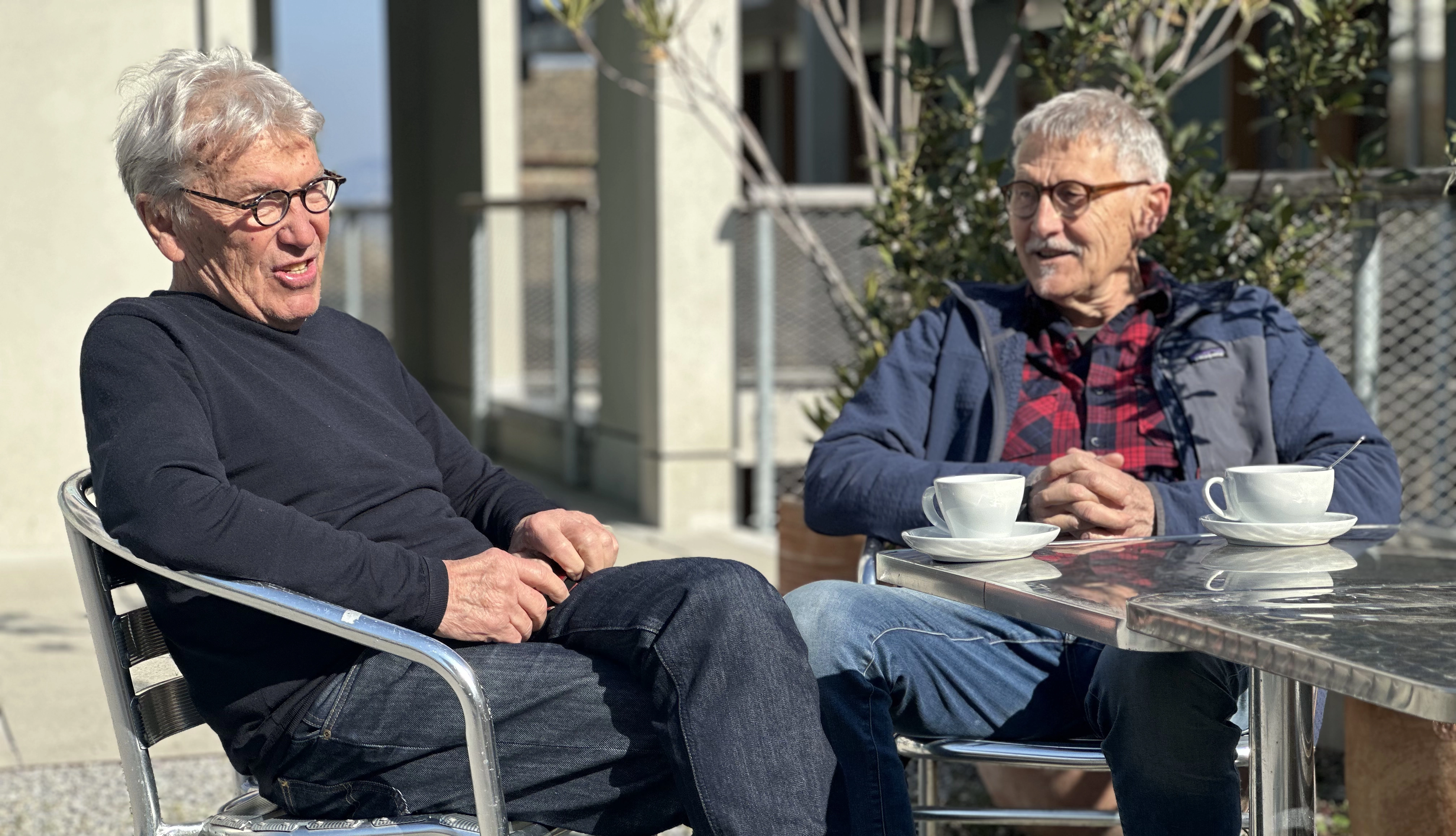
Beat Stünzi and Beat Vogt explain how the vision of «living differently in later life» became a stock corporation, what challenges arose from linking tenancy and share ownership – and how they experienced the switch from intermediated securities to uncertificated securities with Konsento.
Winkelhalden AG in Oberrieden (ZH) combines later-life living with share ownership: everyone who lives in the «Winkelhalden – Anders wohnen im Alter» residential community is also a shareholder of the company. In this interview, Beat Stünzi, member of the Board of Directors, and Beat Vogt, co-founder of Winkelhalden AG, talk about how the idea came about, what self-management looks like in everyday life – and how they experienced the switch from intermediated securities to uncertificated securities with blank assignments.
In the detailed case study, you can find out how Winkelhalden AG restructured its share register with Konsento – and why its annual costs fell by more than 75% in the process.
The idea and vision
How did the idea for Winkelhalden AG come about – what was your goal when you decided to combine living in later life with a stock corporation?
Beat Stünzi: “The vision of ‘living differently in later life’ developed from experiences of seeing acquaintances and parents often living alone and isolated in homes that were too large as they grew older. We chose the stock corporation as the legal form because it allows residents to invest in their development, while the share, as an interest in the whole, shifts the focus away from the private sphere (the apartment) to the community as a whole.”
What does the motto «Living differently in later life» mean to you personally?
Beat Vogt: “For me, it meant daring to try something new again with a view to growing ‘older’: living in a community, self-managed and self-determined.”
Beat Stünzi: “Not looking at life after retirement in the rear-view mirror, but being able to start something new again in a community and actively help shape it. Another aspect is reducing private living space in favour of communal areas.”
Why was it important to you that the residents are not only tenants, but also shareholders of the company?
Beat Stünzi: “One of my central concerns was that, as shareholders, the residents should shift their focus away from the private sphere (the apartment) to the community as a whole.”
Community and responsibility
What advantages do you see in the residents also being co-owners? How does this change everyday life or their attitude towards the development?
Beat Vogt: “Our self-management is based on working groups. Each working group prepares a budget for its area. These budgets, and subsequently the budget discipline as well, show very clearly that the residents see themselves as co-owners and therefore act in a very cost-conscious manner.”
Have there also been moments when this link between tenancy and share ownership led to organisational or legal challenges?
Beat Vogt: “The number of shares held is determined by the size (m²) of the self-occupied floor area, with the price per m² always being the same, regardless of the location of the apartment. For the rents, however, the location of the apartment within the development was assessed. The rent for the most expensive apartment was almost twice as high as that for the least expensive one.
Shortly after moving in, there was a small group of shareholders who disagreed with the valuation of their apartments and therefore with the amount of rent. In a lengthy process, a compromise was developed that all tenants/shareholders agreed to. The community emerged stronger from this process.”
Structural challenges
How did you originally secure this link between the tenancy and shareholder relationship from a legal perspective – and what were the greatest practical difficulties?
Beat Stünzi: “The safeguards were based on the following system:
- articles of association with a transfer restriction clause requiring shareholders to reside in the development
- the shares were held as intermediated securities
- a shareholders' agreement (SHA) with defined call-option events (e.g. upon the death of a shareholder)
- an algorithm defined in an appendix to the SHA for determining the share purchase price annually
- a security and control agreement granting Winkelhalden AG the right to dispose of the shares when a call-option event occurs
- a standard tenancy agreement from casafair (cost-based rent) with detailed ‘Special Provisions and Additional Agreements’ forming part of the tenancy agreement
The system using intermediated securities was rock-solid, but very complex and expensive.”
The original intermediated-securities solution with a bank and control agreement was very robust, but also expensive. What prompted you to look for an alternative?
Beat Vogt: “The trigger for looking for an alternative solution was UBS's takeover of CS, which had previously been the custodian of our intermediated securities, and the resulting constant turnover of the staff responsible for us. Working with CS became increasingly complicated and time-consuming.”
How important was it to you to preserve legal certainty while at the same time making the administration simpler and more independent?
Beat Stünzi: “Legal certainty must be preserved both from the perspective of Winkelhalden AG and from that of the shareholders. With the new system based on simple uncertificated securities and blank assignments, this can be achieved more effectively and at lower cost.”
Collaboration with Konsento
How did you become aware of Konsento – and what convinced you to work with us?
Beat Stünzi: “Through an online search and the resulting opportunity to book a free consultation. What convinced us from the outset was the disruptive approach to share administration, the straightforward, focused discussion and, last but not least, the cost.”
How did you experience the process of converting to simple uncertificated securities and blank assignments? Were there points where you were surprised by how smoothly (or how complexly) it worked?
Beat Vogt: “The conversion to simple uncertificated securities was significantly easier than I had imagined.”
Use and added value
How do you find working with the digital share register today? What concrete advantages do you notice in the Board of Directors' day-to-day work?
Beat Stünzi: “The digital share register gives the Board of Directors greater assurance that transactions, Board meetings and General Meetings are handled in a legally compliant manner. Share administration can be ensured more transparently and with less dependence on individual persons via the Konsento platform. The solution gives shareholders access to their share transactions at any time.”
Which functions or features of the Konsento solution do you particularly value – for example, individual share numbering, attaching legal documents to transactions or the overview of capital contributions?
Beat Vogt: “The clear presentation of transactions in chronological order.”
How did you experience the support and guidance provided by the Konsento team – both during the design phase and in ongoing operation?
Beat Stünzi: “From the very first contact, I was impressed by the fresh dynamism typical of a startup. Konsento immediately understood the core of our not exactly simple model. The subsequent collaboration with Konsento was partnership-based and very focused.”
Looking back and ahead
Looking back today, what does it mean to you that Winkelhalden AG has found a solution that is legally compliant, simple and shareholder-friendly?
Beat Vogt: “I find it very satisfying that our efforts have paid off and that we have now found a simple, future-oriented and cost-effective solution.”
Would you recommend that other organisations planning similar models take a similar approach – and why?
Beat Stünzi: “Our three years of positive experience with completely self-managed community living clearly show that, with our model, we have been able to create a sense of ‘ownership’ in everyday life that is immediately perceptible even to guests and cannot be achieved through conventional renting.”