
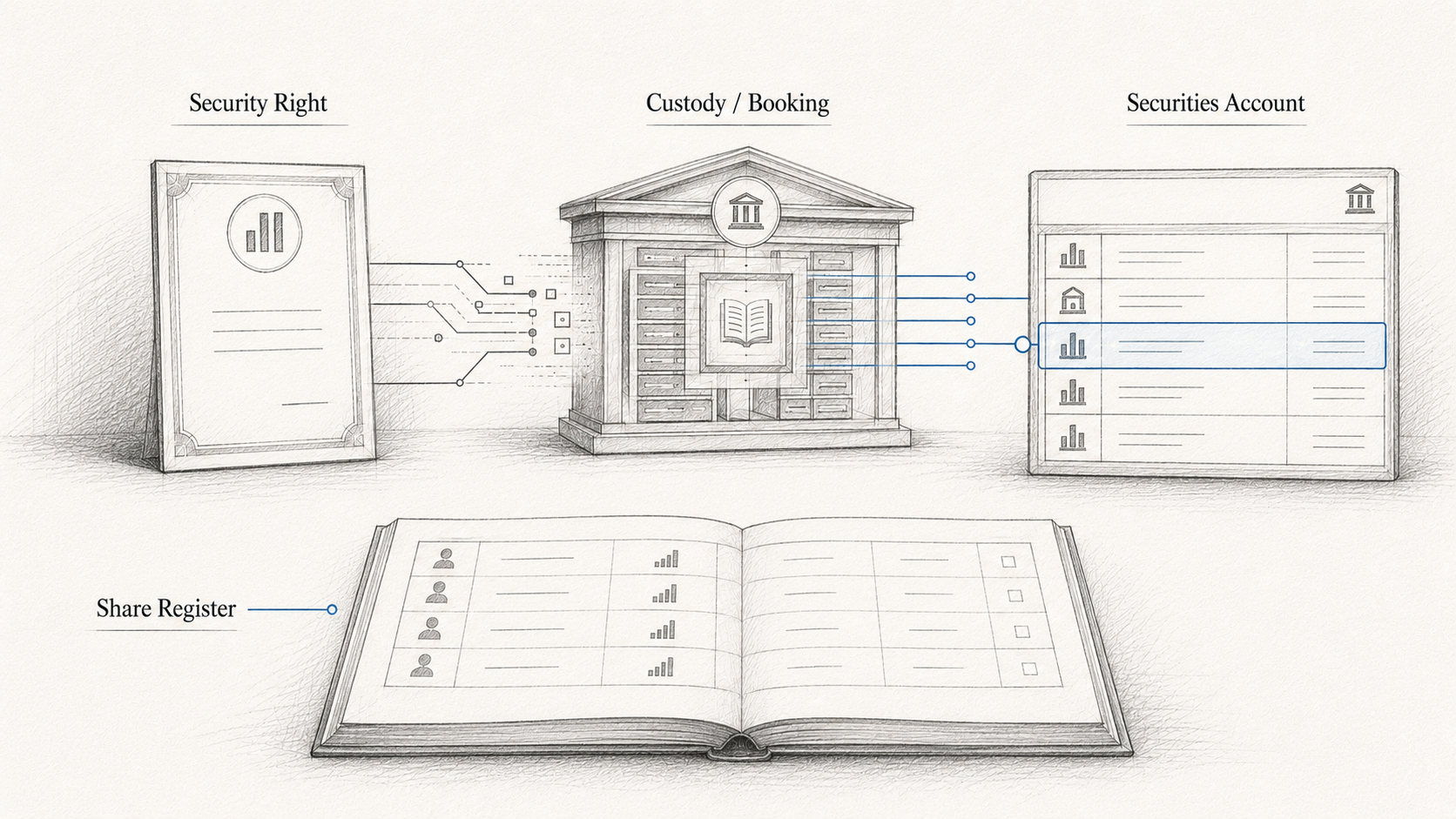
This article explains what intermediated securities are in legal terms and distinguishes them from uncertificated and ledger-based securities. It shows that intermediated securities are not a distinct class of shares, but a special form in which existing corporate rights are held in custody and transferred. The article sets out the legal bases in the Code of Obligations, the Federal Intermediated Securities Act and the Financial Market Infrastructure Act, as well as how intermediated securities arise under Art. 6 and 7 FISA. It also explains why the share register under Art. 686 CO remains central for registered shares, regardless of the custody form chosen.
Anyone looking to digitize the share registry or make the shares of a non-listed Swiss company limited by shares (Aktiengesellschaft, AG) bank-eligible will sooner or later come across three terms: uncertificated securities, ledger-based securities and intermediated securities. In practice, these terms are often used imprecisely. At times, this even creates the impression that intermediated securities are a distinct type of share. This is legally incorrect and can lead to mistaken assumptions when revising the articles of association or connecting to a bank. This article sets out how the three terms relate to one another and answers the basic question that stands at the start of any deeper engagement with intermediated securities: What exactly are intermediated securities in legal terms, how do they relate to uncertificated and ledger-based securities, and what role does the share register play once a company no longer holds its shares on paper but manages them electronically?
Table of Contents
Intermediated Securities Are Not a Distinct Type of Share
The Legal Framework: The CO, FISA and FMIA Together
The Three-Tier Model: Uncertificated Securities, Ledger-Based Securities and Intermediated Securities
How Intermediated Securities Arise: A Basis, Not a Conversion
Why the Share Register Still Matters
Practical Implications for Non-Listed Companies Limited by Shares
Conclusion
Intermediated Securities Are Not a Distinct Type of Share
Under Swiss company law, the term class of shares (Aktiengattung) denotes a category of shares carrying the same rights, for example voting shares, preference shares or shares with a particular nominal value. The first question is always whether a share is a registered share or a bearer share under Art. 622 CO. Intermediated securities operate on an entirely different level: they do not determine which rights a share carries, but how those rights are held in custody and transferred. Intermediated securities are therefore not a distinct class of shares, but a special legal form of custody and disposition over existing corporate rights.
Put simply, an intermediated security is a right credited to an account with a bank or other custodian, allowing the account holder to dispose of it electronically. In practice, this means that a registered share remains a registered share with the same rights, whether it is held on paper, as an uncertificated security, or as an intermediated security. Only the technical and legal form of custody changes, not the substance of the shareholding.
The Legal Framework: The CO, FISA and FMIA Together
The main legal basis for intermediated securities is the Federal Intermediated Securities Act (Bucheffektengesetz, BEG/FISA). It defines what intermediated securities are, which entities may hold them in custody, how they arise, how they are disposed of, and how security interests can be created and enforced over them. Such custodians are primarily banks, securities firms and the central securities depository SIX SIS.
In company law, Art. 622 CO is the starting point. It provides that shares are, in principle, issued as certificated securities. However, a company's articles of association may instead provide that shares are issued as uncertificated securities under Art. 973c or 973d CO, or as intermediated securities under the FISA. Since the revision of Swiss company law, a special rule applies to bearer shares: they are now only permitted if the company has equity securities listed on a stock exchange, or if the bearer shares are structured as intermediated securities and deposited with a specific custodian in Switzerland. What this means in practice for non-listed companies is covered in a separate article in this series.
For market context, it is also worth looking at the Financial Market Infrastructure Act (FinfraG/FMIA). It distinguishes between stock exchanges, multilateral trading facilities and organised trading facilities. SIX Swiss Exchange is a stock exchange. OTC-X, by contrast, is classified as an organised trading facility rather than a stock exchange. Among other things, this distinction affects reporting obligations under the new Transparency Act (TJPG) and the resulting duty to report to Switzerland's national Transparency Register. This too is covered in a separate article in this series.
The Three-Tier Model: Uncertificated Securities, Ledger-Based Securities and Intermediated Securities
Swiss law recognises three tiers for electronically held rights. They build on one another and should therefore not be confused.
The first tier is uncertificated securities under Art. 973c CO. These are rights for which no paper document exists at all. In the case of a company limited by shares, the company itself keeps an internal, non-public record of them, the so-called uncertificated securities book. An uncertificated security arises upon entry in this book. It is transferred by written assignment and pledged under the general rules on the pledging of claims.
The second tier is ledger-based securities under Art. 973d CO. They go one step further than uncertificated securities: they exist only within a specific, technically secured securities ledger, and can only be asserted and transferred through that ledger. This form provides the legal basis for register-based or tokenised rights.
The third tier is intermediated securities under the FISA. They do not compete with the other two forms but build on them. The FISA expressly provides that intermediated securities can arise, among other things, from uncertificated securities or from ledger-based securities once these are booked in with a custodian. Intermediated securities are therefore the most standardised tier, because they connect directly to the custody infrastructure of banks and of SIX SIS.
The following overview summarises the key differences at a glance:
The following overview summarises the key differences at a glance:
How Intermediated Securities Arise: A Basis, Not a Conversion
Under Art. 6 FISA, intermediated securities can arise from four different underlying forms: certificated securities held in collective custody, global certificates, uncertificated securities entered in a custodian's so-called main register, or ledger-based securities that have been transferred to a custodian and immobilised, meaning taken out of circulation, there. In every case, intermediated securities only arise once the credit is made to one or more securities accounts. Importantly, this process does not change the investor's rights against the company as issuer.
The common phrase that uncertificated securities are “converted” into intermediated securities is therefore, strictly speaking, imprecise. It is more accurate to say that intermediated securities are created on the basis of existing uncertificated securities. The term conversion is in fact reserved in the FISA for a different process: under Art. 7 FISA, an issuer may, under certain conditions, change the underlying basis of already existing intermediated securities, for example from certificated securities in collective custody to uncertificated securities. This is generally possible at any time and without the account holders' consent, unless the terms of issue or the articles of association provide otherwise. The total number of rights may not change as a result. The layer of intermediated securities itself continues to exist; only the legal basis beneath it changes.
Why the Share Register Still Matters
For registered shares, the share register remains central even where intermediated securities are used. Under Art. 686 para. 1 CO, the company must keep a share register for its registered shares, recording the name and address of the owners and usufructuaries. This entry is more than a formality: only a person entered in the share register is recognised as a shareholder or usufructuary vis-à-vis the company, and corporate rights can, as a rule, only be exercised once this entry has been made (Art. 689a para. 1 CO).
Intermediated securities do not replace the share register. They standardise ownership and disposition of the share at the level of the custodian, that is, at the bank or at SIX SIS. Under company law, however, registered shares are still tied to the entry in the share register. In practice, a company using intermediated securities therefore usually needs two aligned records: the company-law share register and, depending on the structure chosen, an uncertificated securities book or the corresponding account records held by the custodian. How the share registry, the share register and the securities ledger relate to one another in detail is explained in a separate article.
Practical Implications for Non-Listed Companies Limited by Shares
Not every non-listed company limited by shares needs intermediated securities. For a small, stable shareholder base with few transactions, uncertificated securities are often sufficient: the company keeps its own uncertificated securities book, and transfers take place by written assignment. Intermediated securities become relevant once the shares are meant to enter the custody chain of the financial market, for example a bank custody account, the SIX SIS structure, or later financing and trading processes. The concrete advantages this brings for a company are covered in the next article in this series.
Conclusion
In legal terms, intermediated securities are not a distinct type of share, but a special form in which existing corporate rights are held in custody and transferred. In the three-tier model of Swiss law, they sit above uncertificated securities under Art. 973c CO and ledger-based securities under Art. 973d CO, without replacing them. For registered shares, the share register under Art. 686 CO remains the decisive basis for a shareholder's rights against the company, regardless of the custody form chosen. Understanding this relationship leads to better-informed decisions when revising the articles of association, connecting to a bank, or preparing a financing round.
How Konsento Supports the Creation and Management of Intermediated Securities
A properly maintained share register is the foundation for every further decision around uncertificated and intermediated securities. With Konsento's digital share registry, you keep track of your registered shareholders' entries at all times, fully compliant with the law, regardless of whether your company relies on uncertificated securities, ledger-based securities or intermediated securities.
If a company decides to introduce intermediated securities, Konsento also supports the introduction itself: from reviewing and, where necessary, amending the articles of association, to obtaining an ISIN, to coordinating with the paying agent. Through a direct SECOM connection to SIX SIS, Switzerland's central securities depository, Konsento electronically reconciles the positions in the share registry with shareholders' bank custody accounts on an ongoing basis. This keeps the share registry, the intermediated securities and the custody positions consistently aligned, without the company having to coordinate this reconciliation manually between several parties.