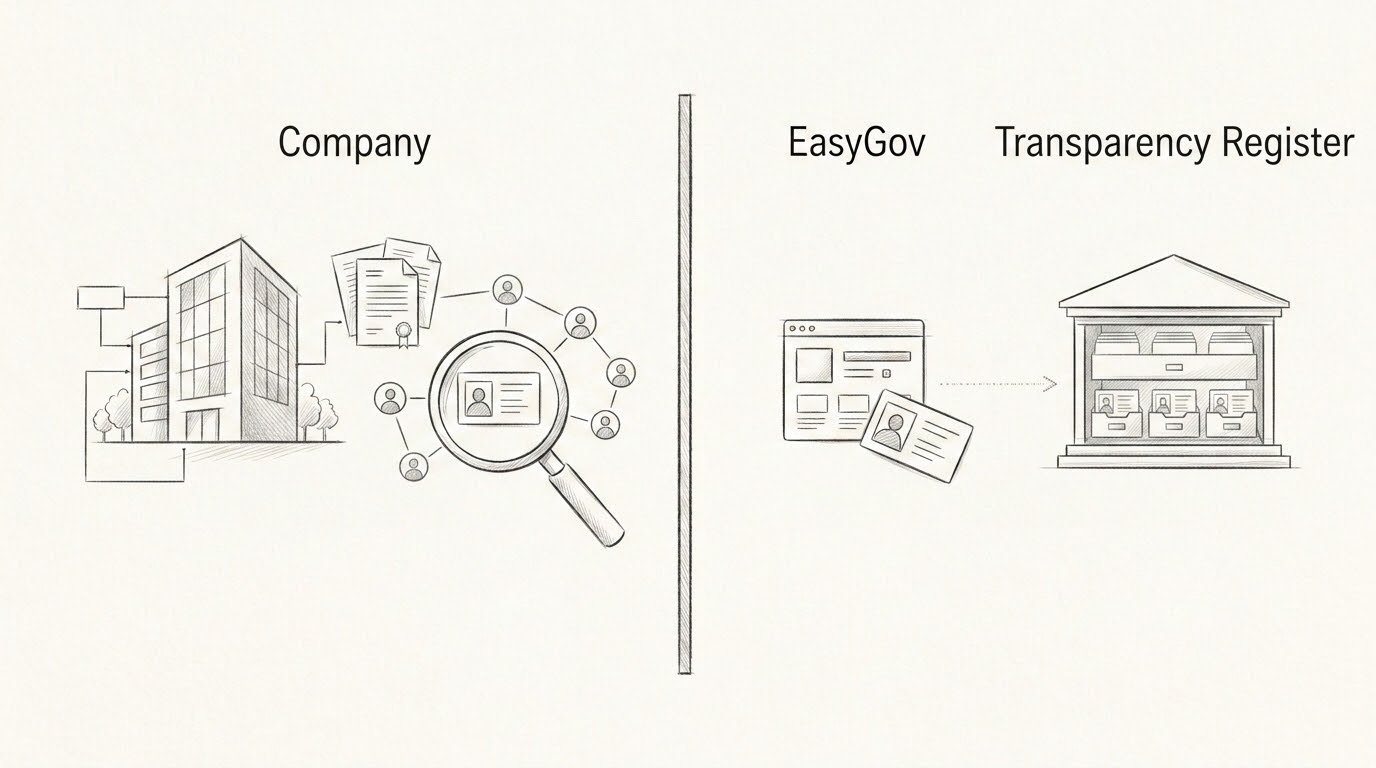
The transparency register and the government's EasyGov reporting platform have a clearly defined role. They receive a completed report, ensure that only authorised persons act, and make the information available to entitled parties. By contrast, determining who qualifies as a beneficial owner and preparing the related documentation take place beforehand within the company and cannot be carried out or made up for in the input form. This article shows where this division of responsibilities lies, why an inaccurate report may later become visible through discrepancy reports and notes, and how identification, documentation and reporting can be combined into an end-to-end process.
On 1 October 2026, the Ordinance on the Transparency of Legal Entities and the Identification of Beneficial Owners (LETO) enters into force, bringing the obligations under the Federal Act on the Transparency of Legal Entities and the Identification of Beneficial Owners (LETA) into effect. From that date, non-publicly listed Swiss legal entities must identify their beneficial owners, verify their identity and status as beneficial owners, and report the relevant information to the transparency register (Art. 7 and 9 LETA). For the time being, the report itself is submitted electronically via EasyGov, the federal government's electronic platform (Art. 22 para. 1 LETA; Art. 26 para. 1 LETO).
Because this transmission channel is technically clearly defined, in practice the new obligation is often reduced to that channel. That view is too narrow. The register receives a completed report and makes the information it contains available to the parties legally entitled to access it. The assessment of who qualifies as a beneficial owner in the first place and how that qualification can be substantiated takes place beforehand and remains the responsibility of the company (Art. 7 para. 1 LETA).
This article therefore answers three interrelated questions. What do the transparency register and the electronic reporting platform do, where does their statutory role end, and what preparatory work must still be carried out by the company? This shows how identification, documentation and reporting can be combined into an end-to-end process that also remains workable when ownership and control relationships change later on.
Table of contents
Purpose of the transparency register
What EasyGov does as the electronic reporting platform
What is checked when a report is submitted – and what is not
The real work happens before the report
After the initial report, the obligation becomes an ongoing process
Where Konsento comes in
Conclusion
Purpose of the transparency register
The transparency register is maintained by the Federal Office of Justice and operated exclusively in electronic form (Art. 20 LETA). It brings together in one place the information on the beneficial owners of reporting legal entities. The legislator is pursuing a clearly defined objective: authorities should have rapid and efficient access to correct, complete and up-to-date information when performing their duties, thereby contributing in particular to combating money laundering, its predicate offences, organised crime and terrorist financing (Art. 1 para. 3 LETA).
In terms of content, the register contains the information reported by the legal entities themselves, supplemented by information entered ex officio (Art. 21 para. 1 LETA). It is therefore not a tool for collecting and analysing information, but a central repository for reports. Accordingly, entries are declaratory and have no constitutive effect (Art. 23 para. 1 LETA). An entry does not create beneficial ownership, and the absence of an entry does not extinguish existing beneficial ownership.
What EasyGov does as the electronic reporting platform
Reports to the transparency register must generally be submitted electronically (Art. 22 para. 1 LETA). The Federal Council has specified this requirement. For the reporting procedure, the legal entity must use the electronic platform under Articles 9–18 of the Federal Act on the Reduction of Regulatory Costs for Businesses (Art. 26 para. 1 LETO). This means EasyGov, the online portal for businesses operated by the State Secretariat for Economic Affairs (Art. 29 para. 3 LETO). In addition, the Federal Department of Justice and Police may provide an interface for electronic transmission and determines its specifications (Art. 26 para. 2 LETO).
EasyGov performs tasks that are indispensable for an official reporting procedure. The key is ensuring that only authorised persons act for a legal entity. To this end, the company must authorise at least one person in writing, who then registers on the platform and authenticates themselves each time they use it (Art. 27 para. 1, Art. 28 and Art. 29 para. 1 LETO). The power of attorney must be signed in accordance with the signatory authority entered in the commercial register (Art. 27 para. 3 LETO). This determines who may validly submit a report.
EasyGov also supports data entry where information can be derived from existing government data sources. For a report of changes, the platform retrieves the existing entry from the transparency register to assist with data entry (Art. 39 para. 2 LETO). Under the simplified reporting procedure, it retrieves information on shareholders or members, or on the board member, from the competent commercial register office (Art. 37 para. 3 LETO). However, this simplified procedure is only available in narrowly defined situations, for example where a company limited by shares has a single natural person as shareholder, who is also registered as its sole board member and is its sole beneficial owner (Art. 36 para. 1 LETO).
In addition to EasyGov, reports can also be made via the commercial register office. However, this is not an independent channel: it requires the company to be registering a fact in the commercial register anyway and to confirm that all beneficial owners are entered there as shareholders or members, or as members of a governing body (Art. 11 para. 1 LETA). The report must be submitted in a document separate from the application for entry in the commercial register (Art. 33 para. 1 LETO). The commercial register office forwards the information received without checking it for accuracy or completeness (Art. 11 para. 3 LETA).
Why an inaccurate report becomes visible
EasyGov asks for the end result. The platform requires information on the reporting legal entity, on each beneficial owner, and on the nature and extent of control exercised (Art. 19 and 20 LETO). At the time of entry, this information must already have been determined, verified and substantiated. The identification of beneficial owners and the assessment of control relationships cannot be carried out or made up for in the input form. Nor is the transparency register itself available to the company as a working environment. The company can submit reports and request correction of its entry (Art. 32 para. 1 LETA), but it cannot work in the register. Data storage and documentation remain within the company.
Incorrect reported information is also unlikely to go unnoticed. Authorities and the supervisory body can access the data online (Art. 25 and 26 LETA), as can financial intermediaries and advisers where necessary to fulfil their due diligence obligations under the Anti-Money Laundering Act (AMLA) (Art. 27 LETA). If a financial intermediary identifies a discrepancy with its own information and the discrepancy persists despite a notice and a reasonable period to resolve it, the financial intermediary must submit a discrepancy report to the transparency register within 30 days (Art. 30 paras. 1 and 2 LETA).
The result is a note on the company's entry indicating doubts about a piece of information (Art. 34 paras. 1 and 2 LETA). It forms part of the register entry and is therefore visible to authorities and financial intermediaries entitled to access the register, which can be awkward, for example, during account-opening processes. Removing the note requires sufficient evidence that the register information is correct, complete and up to date (Art. 36 para. 4 LETA), and the authority charges time-based fees for requests and orders (Art. 68 paras. 1 and 2 LETO). Anyone who intentionally breaches the reporting obligation or provides false information to the supervisory body may be fined up to CHF 500,000 (Art. 43 lit. b and c LETA); anyone who fails to comply with a final and binding order may be fined up to CHF 100,000 (Art. 44 LETA).
The quality of a report is therefore determined not in the input form, but by the work that precedes it.
The real work happens before the report
Once the register receives the result, the question is how that result was reached. The Act answers this clearly. Identification, verification and documentation are obligations of the company, and in substantive terms they are more demanding than the subsequent transmission.
Identification and verification
The company must identify its beneficial owners and obtain their surname and first name, date of birth, nationality, address and country of residence, as well as the required information on the nature and extent of control exercised (Art. 7 para. 1 LETA). That is not enough. It must verify the identity of these persons and their status as beneficial owners with the due care required in the circumstances, and request relevant supporting documents from shareholders, beneficial owners or third parties (Art. 7 para. 2 LETA). The Ordinance specifies that the company must determine whether the person concerned has an AHV number and, if not, obtain a copy of their passport, identity card or foreign national identity card (Art. 10 para. 2 LETO).
Nature and extent of control
For each beneficial owner, the company must determine whether that person exercises control alone or acting in concert with third parties, directly or indirectly, and through an ownership interest or by other means (Art. 12 LETO). If control is based on an ownership interest, the relevant range must also be determined (Art. 13 para. 1 LETO). If several persons exercise control acting in concert, the threshold applies to the ownership interest held jointly, not to each person's individual ownership interest (Art. 13 para. 2 LETO).
It becomes more demanding where control is not linked to a percentage ownership interest. A natural person controls a legal entity by other means, among other things, if they have the right or actual ability to appoint or remove more than half of the members of the management or administrative body, to veto certain decisions or to cause decisions on profit distributions to be made (Art. 3 para. 1 LETO). Such positions can arise from agreements with shareholders, from capital instruments such as options, convertible bonds or profit-participating loans, from provisions in the articles of association, from legal representation relationships, fiduciary arrangements or relationships between related persons (Art. 3 para. 2 LETO).
Where multi-tier structures are involved, additional information must be obtained about the natural persons, legal entities or trusts that form part of the chain of control. This applies in particular where the chain includes at least two intermediate links or at least one trust or fiduciary arrangement (Art. 15 para. 1 LETO). None of these questions can be answered simply by filling in a form. They require the underlying agreements, articles of association and ownership relationships to be known and legally assessed.
Documentation and record-keeping
The information obtained must be documented and kept up to date, and it must be accessible in Switzerland at all times (Art. 8 para. 1 LETA). If identification or verification is unsuccessful, that fact and the steps taken must be documented (Art. 8 para. 2 LETA) and disclosed in the report (Art. 9 para. 3 LETA). The information and supporting documents must be retained for ten years after the person concerned ceases to be a beneficial owner (Art. 8 para. 3 LETA).
This documentation does not exist in the transparency register. It remains within the company and must remain retrievable there even if the responsible person leaves the company.
Responsibility and cooperation by third parties
The most senior member of the governing body is responsible for the reports. That person may delegate the task to other persons within the company or to third parties, but remains responsible for the proper submission of the report (Art. 12 LETA). The company is not entirely on its own, however. Shareholders who, alone or together with third parties, hold ownership interests to an extent that enables ultimate control must report the beneficial owner to the company (Art. 13 para. 1 LETA). The beneficial owners and third parties involved in the chain of control must cooperate with the verification (Art. 14 para. 3 LETA). These cooperation obligations do not, however, relieve the company of its own obligation. They give the company a right to information that it must actively exercise and whose outcome it must verify.
After the initial report, the obligation becomes an ongoing process
Ownership structures change. Shareholders join or leave, ownership interests are transferred, personal data changes, and control positions shift. The Act takes account of this. The company must report any change to a fact entered in the transparency register within one month after becoming aware of it (Art. 10 LETA).
Not every change in the shareholder base triggers a report. A change in an ownership interest only has to be reported if it causes a threshold to be crossed upwards or downwards (Art. 39 para. 3 LETO). For certain changes that are updated in the commercial register anyway, such as the company name, legal form or registered office, the reporting obligation does not apply (Art. 39 para. 4 lit. a LETO).
This distinction, however, requires the company to maintain an up-to-date understanding of its ownership and control relationships. If the company does not know its current ownership percentages, it cannot assess whether a transaction affects a threshold. There is also the ongoing obligation to keep the documented information up to date (Art. 8 para. 1 LETA).
There is some flexibility in terms of timing, but not much. The Ordinance enters into force on 1 October 2026 (Art. 71 LETO). Legal entities under Swiss private law must submit the required report within one month after the first change to their commercial register entry following entry into force, but no later than within the special transitional periods (Art. 51 para. 1 LETA). If all beneficial owners are entered in the commercial register as shareholders or members, or as members of a governing body, the period is two years (Art. 51 para. 2 LETA). In all other cases, it ranges from three to six months depending on the legal form and audit requirement (Art. 51 para. 3 LETA).
Where Konsento comes in
Konsento replaces neither the transparency register nor the electronic reporting platform. Both fulfil a statutory role. For the time being, the report itself is submitted via the prescribed electronic channel (Art. 26 para. 1 LETO). Konsento comes in where the quality of that report is created.
The digital share register provides the structured foundation. Shareholders, ownership interests and share classes are maintained in one place; beneficial owners can be recorded for each ownership interest and share class; and validity dates make it possible to see which relationships applied at any given time. Investors and the company work from the same data set, reducing follow-up questions and duplicate data maintenance. This share-register functionality is free for companies with up to 150 shareholders.
On this foundation sits the Transparency Register Assistant, a separate paid product. It guides users step by step through the identification of beneficial owners and consistently applies the logic of LETA and LETO to the recorded structure. It covers not only direct holdings, but also multi-tier chains of control, control by other means, acting in concert, as well as fiduciary, trust and foundation structures. Chains of control are visualised graphically, and the process produces a structured documentation dossier together with the prepared reporting data.
In addition, ongoing monitoring of ownership relationships helps identify changes at an early stage so that their relevance for a report of changes can be assessed. This means the assessment does not have to start from scratch the next time something changes.
The benefit therefore does not lie in recreating a government form in another interface. It lies in ensuring that, at the time of reporting, the underlying data and decision-making basis already exists, has been verified and is documented. As a by-product, this also creates a basis that can be explained in a comprehensible manner to banks and financial intermediaries.
Conclusion
The transparency register and the electronic reporting platform solve a different problem from the company's preparatory work. The register brings together the reported information and makes it available to entitled parties (Art. 1 para. 3 LETA). The platform ensures that reports are submitted electronically, by authorised and authenticated persons, and are formally complete (Art. 27–30 LETO). Both are necessary, and both only work if the reported information is substantively correct.
The assessment of who qualifies as a beneficial owner, what type of control exists and how it can be substantiated takes place beforehand and remains the responsibility of the company (Art. 7 and 8 LETA). This work cannot be shifted into an input form. But it can be prepared, structured and documented in a way that means the next change does not require starting from scratch.
For simple structures, the effort remains manageable, and for certain situations the Ordinance even provides for a simplified reporting procedure (Art. 35 and 36 LETO). Once intermediate companies, shareholders' agreements, convertible bonds, fiduciary arrangements or groups of shareholders acting in concert are involved, however, the focus shifts clearly to the preparatory work. If you address this work early, there is little left to do when the report itself is submitted.
So check in good time whether your ownership and control relationships are recorded and documented in a way that allows you to substantiate your company's beneficial owners. If you want to create a structured foundation for this, record your company, shareholders and ownership interests in Konsento and then use the Transparency Register Assistant to identify the beneficial owners and prepare the report.