
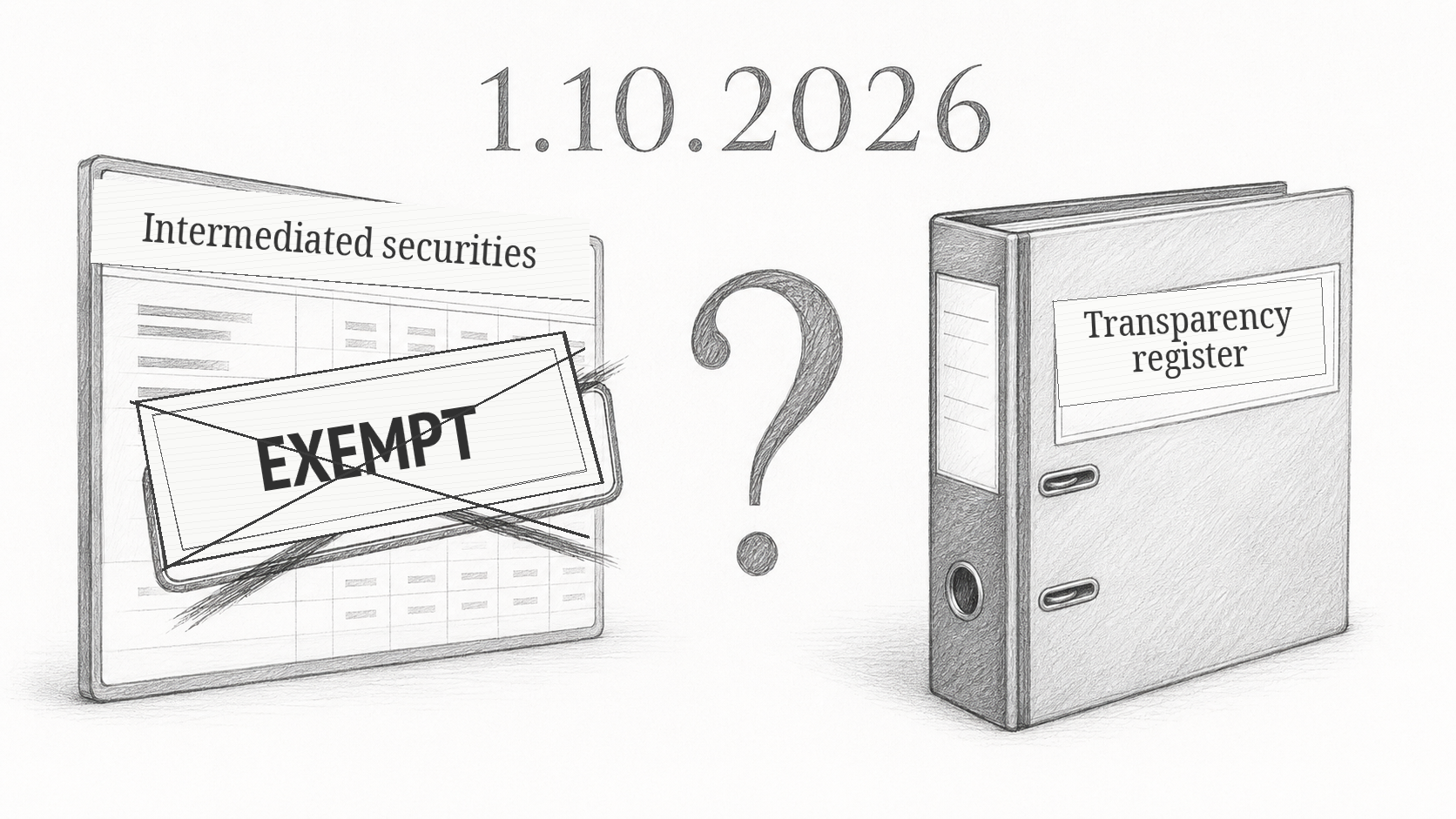
This article explains why the previous intermediated securities exemption from the beneficial-owner reporting duty falls away once the Transparency Act (TJPG) enters into force on 1 October 2026. Drawing on Art. 697j para. 5 CO and Art. 3 TJPG, it shows which companies remain exempt and which become newly subject to the reporting duty – in particular companies with untraded intermediated securities and companies whose shares are traded on an organised trading facility such as OTC-X. The article also assesses the role of voluntary transparency standards and sets out practical next steps.
Under the law currently in force, companies limited by shares whose shares are structured as intermediated securities benefit from an exemption from the duty to identify and report the beneficial owner. With the new Transparency Act (TJPG), which enters into force on 1 October 2026, the legal basis for this exemption is repealed. For many companies with intermediated securities, this raises a concrete question: does the existing relief continue to apply, or will they newly have to report to the Transparency Register? This affects not only companies whose shares are traded on a venue such as OTC-X, but also companies that use intermediated securities purely for collateral or custody purposes. This article sets out the legal position and shows who will be subject to the reporting duty going forward and who will not.
Table of Contents
The Previous Legal Position: The Intermediated Securities Exemption under Art. 697j Para. 5 CO
The TJPG Repeals Art. 697j CO without Replacing the Intermediated Securities Exemption
Consequence 1: Intermediated Securities with an Exchange Listing Remain Exempt
Consequence 2: Intermediated Securities without a Trading Venue Lose the Exemption
Consequence 3: Intermediated Securities Traded on an Organised Trading Facility such as OTC-X
OTC-X's Voluntary Transparency Standards Are Not a Substitute
Practical Implications for Affected Companies
Conclusion
The Previous Legal Position: The Intermediated Securities Exemption under Art. 697j Para. 5 CO
Under current law, a shareholder who, alone or acting in concert with third parties, reaches or exceeds 25 percent of a company's share capital or voting rights must report the beneficial owner to the company (Art. 697j para. 1 CO). Since 2015, an exemption from this reporting duty has applied to companies with intermediated securities: if the shares are structured as intermediated securities and deposited with a custodian in Switzerland or entered in the main register, the reporting duty does not apply (Art. 697j para. 5 CO). The company designates the custodian for this purpose.
The rationale behind this: once shares are held as intermediated securities with a bank or another financial intermediary, that intermediary is itself subject to the due diligence duties under the Anti-Money Laundering Act and must in any case establish the beneficial owner of its client. An additional report to the company therefore appeared to be a duplicate duty without real added value. Importantly, this exemption is tied exclusively to the custody form. Whether the shares are traded at all, and where, is irrelevant to the previous exemption.
The TJPG Repeals Art. 697j CO without Replacing the Intermediated Securities Exemption
With the entry into force of the Federal Act on the Transparency of Legal Entities and the Identification of Beneficial Owners (TJPG) on 1 October 2026, Art. 697j CO is repealed in full, as are the related provisions in Art. 697i and Art. 697l CO. The substance of the previous reporting duty continues in Art. 13 TJPG, supplemented by the company's new duty to also report the information to the central, non-public federal Transparency Register.
Art. 3 TJPG governs the exemptions. Under this provision, exempt entities include, in particular, companies whose equity securities are wholly or partly listed on a stock exchange, as well as their majority-owned (more than 75 percent) subsidiaries. The Federal Council's dispatch specifies this exemption further: it applies to companies listed on a Swiss stock exchange within the meaning of Art. 26 let. b FMIA, or on a foreign stock exchange with equivalent disclosure duties. The exemption is justified by reference to the disclosure duties under Art. 120 FMIA: anyone who reaches or exceeds a certain proportion of voting rights in an exchange-listed company must report this to the company and to the disclosure office, and this information is published. An additional report to the Transparency Register would offer no added value in this case. We have compiled a general overview of the TJPG reporting duty and its further exemptions, such as for pension funds, in a separate article.
The TJPG no longer provides a standalone exemption for intermediated securities. This has different consequences for companies with intermediated securities, depending on whether and where their shares are traded.
Consequence 1: Intermediated Securities with an Exchange Listing Remain Exempt
If a company with intermediated securities is also listed on a stock exchange within the meaning of Art. 26 let. b FMIA, nothing fundamental changes for it. It continues to benefit from the exemption under Art. 3 TJPG – no longer because its shares are structured as intermediated securities, but because it is exchange-listed. Under the old law, the two connecting factors often coincided, because exchange-listed shares are, as a rule, held as intermediated securities in any case. Under the TJPG, however, the exchange listing alone is decisive, not the custody form.
Consequence 2: Intermediated Securities without a Trading Venue Lose the Exemption
The position is different where a company structures its shares as intermediated securities without these being traded on any venue. This concerns, in particular, companies that use intermediated securities for practical reasons: to make shares bank-eligible so that they can be booked into their shareholders' custody accounts, or to pledge them as collateral for a credit facility, for example as part of an M&A financing. We cover the use of intermediated securities as loan collateral in more depth in a separate article in this series. These companies previously benefited from the intermediated securities exemption under Art. 697j para. 5 CO, regardless of any listing. Because the TJPG does not provide for this exemption and the company is not exchange-listed, the exemption is lost entirely. Going forward, it must identify its beneficial owners and report them to the Transparency Register, just like any other non-listed company limited by shares.
Consequence 3: Intermediated Securities Traded on an Organised Trading Facility such as OTC-X
The third case concerns companies whose intermediated securities are traded on a venue such as OTC-X, operated by Bern Cantonal Bank (BEKB). At first glance, it might seem reasonable to assume that an actively traded security is equivalent to an exchange-listed share. Legally, however, this is not the case.
The Financial Market Infrastructure Act draws a clear distinction between stock exchanges (Art. 26 ff. FMIA) and organised trading facilities (Art. 42 ff. FMIA). OTC-X is classified by its own operator as an organised trading facility, not as a stock exchange. This distinction is not merely terminological; it has a concrete consequence: the disclosure duties under Art. 120 FMIA, which the dispatch cites to justify the TJPG exemption for exchange-listed companies, apply exclusively to exchange-listed companies. They do not exist for securities traded on an organised trading facility. The justification for the exemption is therefore absent, as is its formal precondition.
Companies whose intermediated securities are traded on OTC-X were therefore previously exempt from the reporting duty under Art. 697j para. 5 CO, just like any other company with intermediated securities. With its repeal by the TJPG, however, they lose this exemption – and, unlike exchange-listed companies, they receive no replacement for it, because OTC-X is legally not a stock exchange. They will be subject to the Transparency Register reporting duty from 1 October 2026.
OTC-X's Voluntary Transparency Standards Are Not a Substitute
Bern Cantonal Bank promotes a degree of transparency on OTC-X: many companies traded there voluntarily publish annual reports and information about their shareholder structure. This is valuable for investors, but it does not substitute for a statutory duty. Unlike on SIX Swiss Exchange, there is no duty on OTC-X to continuously report changes in shareholdings once certain thresholds are crossed, and no prohibition on creeping acquisitions of voting rights. A company's voluntary disclosure does not change the fact that it must independently identify its beneficial owners and report them to the Transparency Register.
Practical Implications for Affected Companies
For companies that have previously benefited from the intermediated securities exemption and will no longer do so from 1 October 2026, this creates concrete action items. They must identify their beneficial owners, verify the information provided with the requisite care, and document it. The information must be kept up to date both vis-à-vis the company and vis-à-vis the Transparency Register. Building the corresponding structures and processes early reduces the effort involved in the initial filing and avoids deadline problems.
The following overview summarises the three scenarios:
Conclusion
The former intermediated securities exemption from the reporting duty falls away entirely once the TJPG enters into force, with no replacement. Going forward, the sole decisive factor is whether a company is listed on a stock exchange within the meaning of Art. 26 let. b FMIA. Companies with intermediated securities that meet this condition remain exempt. All others – whether their intermediated securities serve untraded collateral or custody purposes, or are traded on an organised trading facility such as OTC-X – will have to report their beneficial owners to the Transparency Register.
How Konsento Supports Reporting to the Transparency Register
Companies that still benefit from the old intermediated securities exemption today should prepare for the new legal position early. Konsento's digital share registry already offers structured management of beneficial owners' master data: it is recorded per shareholding and share class, documented in a historically traceable way, and linked directly to the relevant share position, rather than kept in a separate list. Both the company and the investor can maintain the information, and a monitoring feature flags whenever a change to the shareholder structure or the master data requires a renewed report to the Transparency Register.
This applies regardless of the form in which your company holds its shares: the share registry for intermediated securities can also be managed directly through Konsento. Through a direct SECOM connection to SIX SIS, Konsento reconciles the positions in the share registry electronically and on an ongoing basis with shareholders' bank custody accounts. This data foundation can be used directly to assign beneficial owners to the relevant shareholding, instead of having to compile it separately.
The initial filing to the Transparency Register can be made using Konsento's Transparency Register filing assistant. It guides users through the complete identification of beneficial owners: from the initial capture of the company to the full analysis of chains of control, trusts and foundations under Swiss law, where relevant. Every step follows the rules of the Transparency Act and its implementing ordinance. The process concludes with a plausibility check and a complete preview of the filing content.
This process produces several outputs that are useful beyond the filing itself: an automatically generated visualisation of the chain of control showing the capital and voting-rights shares at each level, a multi-part documentation file recording the entire identification process, including persons examined and ruled out, a pre-filled Form K under CDB 20 for the banking relationship, an integrated sanctions screening, and a structured CSV export. These documents can be used independently of the actual filing to the register, for example in an internal compliance file or vis-à-vis the bank.