
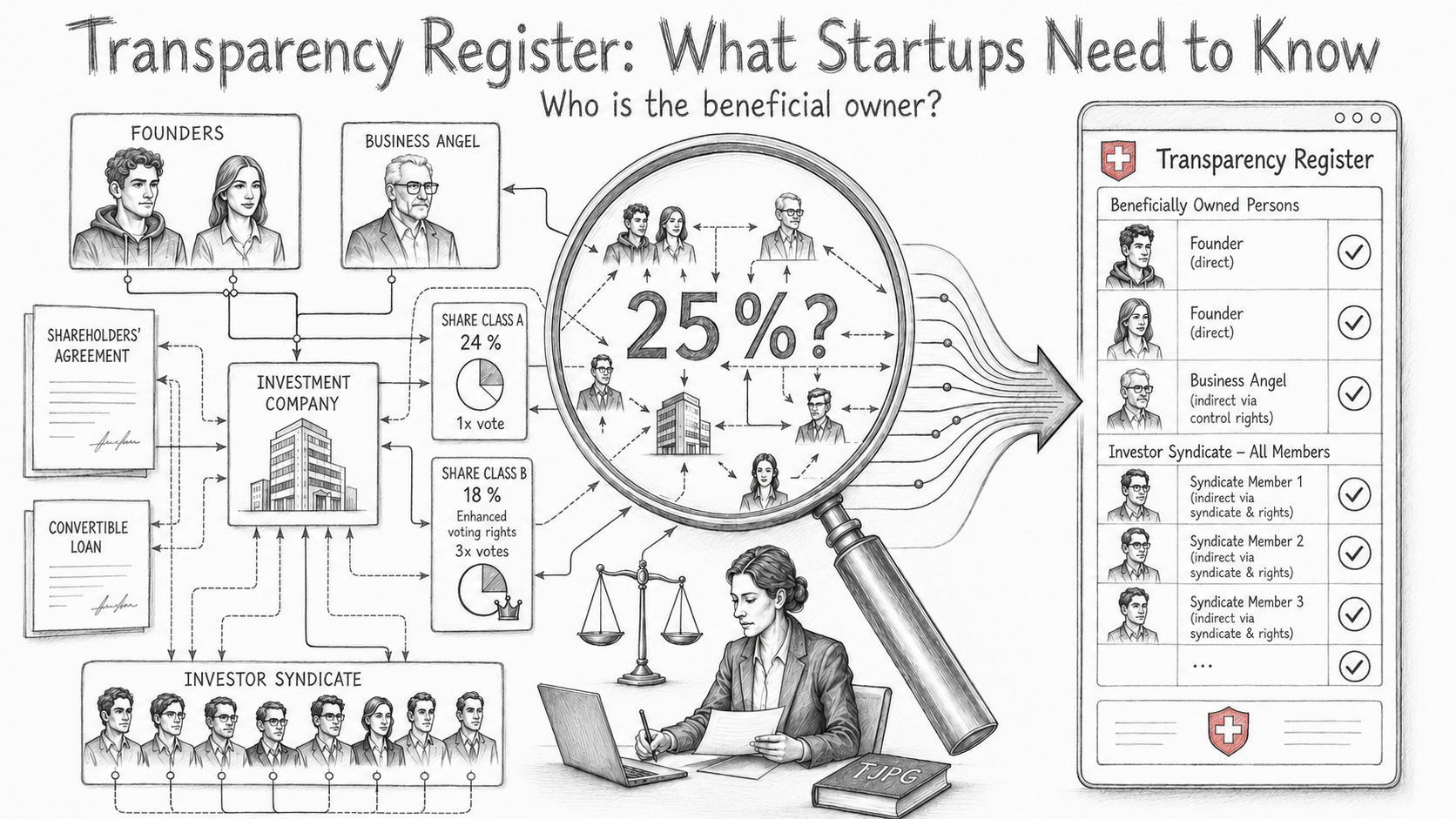
As of 1 October 2026, Swiss startups too must report their beneficial owners to the new transparency register. This article shows why this obligation is more complex for startups than for classic SMEs, for instance because of shareholders' agreements, investor syndicates, convertible loans, and shares with different voting rights. It explains when holdings under 25 percent also become reportable, and how the thresholds of 25, 50, and 75 percent trigger later reports of changes. It also looks at how startups can prepare for this recurring reporting obligation in a structured way already now.
As of 1 October 2026, Switzerland's new Federal Act on the Transparency of Legal Entities and the Identification of Beneficial Owners, or LETA for short, enters into force. Every non-listed Swiss stock corporation or limited liability company, and therefore practically every startup, must identify its beneficial owners and report them to the new federal transparency register (Art. 9 LETA). For an established family-owned company with two or three shareholders, this exercise is usually done within minutes. For a startup, the starting position often looks different. Several co-founders, a shareholders' agreement, an investor syndicate, an outstanding convertible loan, different share classes with and without enhanced voting rights, and on top of that the next financing round already in preparation. It is precisely in such constellations that the question of who actually qualifies as a beneficial owner becomes noticeably more complex than the well-known 25 percent rule of thumb suggests at first glance. This article shows what founders, as well as board members, of Swiss startups and scaleups should specifically watch out for when implementing LETA.
Contents of this article
Who qualifies as a beneficial owner at a startup
Shareholders' agreements and the question of joint control
Informal arrangements between co-founders
Investor syndicates and the partner assembly
Convertible loans as control by other means
Shares with multiple voting rights and participation certificates
Reports of changes as a recurring theme in a startup's growth
Further points startups easily overlook
Why it pays to prepare now
How Konsento supports startups with implementation
Who qualifies as a beneficial owner at a startup
A beneficial owner is any natural person who ultimately controls a company, whether directly or indirectly with at least 25 percent of the capital or the voting rights, or in some other way (Art. 4 para. 1 LETA). At a smaller family-owned company, this question can usually be answered directly from the share register. At a startup, however, looking at the ownership percentages alone is often not enough. Who actually controls the company frequently only becomes clear from the interplay of ownership interests, contractual arrangements between shareholders, financing instruments, and voting-right structures. The following sections address the constellations that occur particularly often in practice at startups and scaleups, and that are easily overlooked when identifying beneficial owners.
Shareholders' agreements and the question of joint control
Many startups govern the relationship between their shareholders in a shareholders' agreement that provides, for example, rights of first refusal, co-sale rights, or voting commitments on individual agenda items. However, such an agreement does not automatically mean that the parties involved act in concert within the meaning of the Transparency Act and therefore jointly qualify as beneficial owners. Acting in concert exists when several persons coordinate their conduct with third parties in order to exercise control over the company, whether through an ownership interest or by other means (Art. 4 LETO). A shareholders' agreement is an indication in this regard, but not automatic proof. What matters is whether the agreement objectively enables the parties to jointly exercise control over the company, and whether the circumstances suggest that such control is actually being pursued. Each case therefore requires an individual assessment.
Particular caution is warranted where a shareholders' agreement does not bind all shareholders but only some of them, and sets specific resolution quorums or blocking minorities that must be reached for a goal to be pushed through that is in the common interest of all parties to that agreement. If, for example, three of seven shareholders agree that important resolutions can only be passed with the consent of all three, and these three persons together hold a relevant ownership interest, much suggests that the agreement is intended to confer joint control within the meaning of the law. Such a quorum only makes sense, after all, if the parties intend to act as a united front at the decisive moment. In this case, all parties to the agreement must be reported as beneficial owners, including those who individually hold less than 25 percent of the capital or the votes. What matters is not the individual holding of each person, but the ownership interest held jointly by the group, while the identity of each individual person must still be established and reported separately (Art. 13 para. 2 LETO).
Informal arrangements between co-founders
Acting in concert does not need to be set out in writing. An informal understanding can also be relevant if it enables several persons to exercise their voting rights in a coordinated manner (Art. 4 LETO). This is particularly relevant in practice for startups, because co-founding teams naturally work closely together and already agree on many issues. From the perspective of the Transparency Act, it becomes problematic where this cooperation goes beyond day-to-day operational collaboration and turns into systematic, coordinated voting behaviour toward other shareholders, for instance where several co-founders regularly and recognisably vote as a bloc against the position of individual other shareholders on unpopular decisions. What matters is whether a minimum degree of internal purposefulness and a certain external organisation of the voting behaviour is discernible, and whether this behaviour is objectively capable of securing control over the company for the group. A single joint decision generally does not yet constitute acting in concert. A recurring, recognisably coordinated pattern, however, very well can.
Investor syndicates and the partner assembly
Business angels and smaller investors frequently pool their stake in a startup into an investor syndicate, which is usually structured under Swiss law as a simple partnership and makes a single investment on behalf of all participants. In the Swiss startup scene, the freely available SISAT template for syndicate agreements has become established for this purpose. A typical element of such syndicate agreements is the partner assembly, at which the syndicate's members determine their joint voting position ahead of the startup's general meeting, which a lead partner then represents at the general meeting. If such a syndicate together reaches an ownership interest of at least 25 percent of the capital or the votes and determines its voting position in this coordinated manner, this regularly constitutes acting in concert within the meaning of the Transparency Act (Art. 4 LETO). The consequence is the same as for a shareholders' agreement with a blocking minority. Not only the lead partner, but every individual member of the syndicate must be identified and reported as a beneficial owner, even if that member's individual stake in the startup is, on its own, well below 25 percent.
Convertible loans as control by other means
Many startups finance themselves between two financing rounds with a convertible loan that is only converted into shares at the next round. From the perspective of the Transparency Act, such an instrument can already confer control before conversion. The ordinance expressly names debt instruments such as convertible bonds or profit-participating loans as one of the forms by which control by other means can be exercised (Art. 3 para. 2 let. b LETO). This becomes particularly relevant where a convertible loan is linked to veto rights or consent requirements for material decisions, for example on budget, investment planning, or further debt or equity financing, since such rights can on their own already constitute control by other means (Art. 3 para. 1 let. b LETO). Startups that take on a convertible loan should therefore assess already at that point, rather than only upon conversion into shares, whether the investing person thereby becomes a beneficial owner.
Shares with multiple voting rights and participation certificates
For the 25 percent threshold, the Transparency Act looks at the capital or the voting rights and takes whichever of the two figures is higher (Art. 4 para. 1 LETA). This is particularly relevant for startups, because founders may be diluted in capital terms over several financing rounds, yet deliberately retain their influence at the general meeting through shares with enhanced voting rights. If, for example, a founder still holds 18 percent of the capital but, thanks to founder shares with multiple voting rights, still holds 30 percent of the votes, she must be reported as a beneficial owner, because the higher of the two figures is decisive for the threshold calculation. Conversely, the same applies to participation certificates, which carry an interest in the capital but no voting rights. Anyone who holds not a single vote but, through participation certificates alone, holds 25 percent or more of the company's total capital likewise qualifies as a beneficial owner, even though this constellation is comparatively rare at young startups.
Reports of changes as a recurring theme in a startup's growth
For most companies, the initial report to the transparency register is the most demanding step. For a growing startup, it is often rather the opposite. Financing rounds, the departure of a co-founder, the arrival of a late co-founder, or the exercise of employee participation plans regularly change the ownership structure and can overtake reports already filed. Any change to a fact entered in the transparency register must be reported within one month of the company becoming aware of it (Art. 10 LETA). In practice, this one-month period is often referred to as a 30-day deadline.
Not every shift in an ownership interest, however small, triggers a new report. What matters for reporting purposes are the three bands that the ordinance provides for the extent of an ownership interest.
An ownership interest only needs to be reported if a change causes one of these thresholds to be crossed, upward or downward (Art. 39 para. 3 LETO). If an ownership interest moves from 30 to 40 percent, it stays within the same band and does not trigger a reporting obligation. If it rises from 24 to 26 percent, from 49 to 51 percent, or from 74 to 76 percent, however, it crosses one of the three thresholds each time and must be reported within one month. For startups with frequent financing rounds and an evolving ownership structure, this means that these three thresholds must be kept under continuous review, not just once at incorporation or at the initial report.
It is also important that newly founded companies are subject to the obligation from the outset. Anyone incorporating a startup as a stock corporation after the Act enters into force must make the report to the transparency register within one month of entry in the commercial register (Art. 9 para. 4 LETA), without benefiting from the longer transition periods that apply to already existing companies.
Further points startups easily overlook
Startups raising capital from business angels occasionally encounter holdings that are not held directly but on a fiduciary basis, for instance where an investor invests through a nominee structure or a special purpose vehicle. In these cases too, the person on whose account the holding is held remains the beneficial owner. In addition, the shareholder acting in a fiduciary capacity must disclose this fiduciary arrangement to the company, within one month of it being established (Art. 16 LETA). Startups that do not keep their investor structure continuously documented risk overlooking such fiduciary arrangements when identifying beneficial owners.
The verification steps for reporting to the transparency register
Regardless of whether it is an established SME or a growing startup, identifying beneficial owners follows essentially the same verification process at its core. The difference lies not in the structure of this process, but in the attention that must be paid to the particularities of a startup's financing structure. Anyone familiar with the constellations described in this article can take these particularities into account.
The verification process in its basic structure
In its basic structure, the verification process can be broken down into the following checkpoints.
- Record the ownership structure. Establish who holds which capital interests and which voting rights, broken down by share or membership-interest category.
- Check control through an ownership interest. Establish which natural persons directly or indirectly, via a chain of control, hold at least 25 percent of the capital or the voting rights (Art. 1 and Art. 2 LETO).
- Check control by other means. Independently of the outcome of the preceding checkpoint, determine whether persons control the company through instruments such as veto rights, representation relationships, or certain capital instruments (Art. 3 LETO). Unlike the well-known three-tier cascade under CBD 20, control through an ownership interest and control by other means must be assessed cumulatively under LETA, not sequentially.
- Check acting in concert. Establish whether several persons exercise control in a coordinated manner and thereby jointly reach a relevant threshold (Art. 4 LETO).
- Verify and document identity. Identify the persons established, verify their details, and document the verification process in a traceable manner (Art. 7 LETA).
- Report on time. Submit the results to the transparency register within the statutory deadline (Art. 9 LETA).
- Monitor on an ongoing basis. Keep the ownership and control structure under continued review and report changes within one month (Art. 10 LETA).
What startups should pay particular attention to at each checkpoint
At a startup, almost every one of these checkpoints deserves extra attention that is rarely necessary for a classic SME structure. At the first checkpoint, looking at the share register is often not enough, because the capital interest and the voting right can diverge, for example through founder shares with enhanced voting rights or through participation certificates. In every case, the higher of the two figures is decisive.
At the second and third checkpoints, startups need a deliberate review of instruments that are rare at established SMEs, namely convertible loans with veto rights and other financing instruments that can confer control even before shares are actually issued.
The fourth checkpoint, checking for acting in concert, is particularly important for startups and is the one most often overlooked in practice. Shareholders' agreements with blocking minorities, coordinated voting behaviour within the founding team, and investor syndicates with a partner assembly must all be actively considered here, even if no single person individually reaches the 25 percent threshold.
The last checkpoint, ongoing monitoring, is not a side issue for a growing startup but a recurring task. Financing rounds, departures from the founding team, and employee participation schemes regularly overtake the structure once reported, often several times in the same year.
Anyone who works through this verification process from the outset with an eye to their own contractual arrangements, financing instruments, and ownership interests significantly reduces the risk of overlooking beneficial owners when reporting.
Why it pays to prepare now
The constellations described show that identifying beneficial owners at a startup is rarely a one-off, purely administrative exercise. It requires an ongoing engagement with the shareholder structure, the existing agreements between shareholders, and the financing instruments reflected in the cap table. Anyone who only starts shortly before the relevant deadline risks misjudging complex structures such as syndicates, convertible loans, or shares with multiple voting rights under time pressure. It therefore pays to record the relevant master data, ownership interests, and agreements in a structured way already now, even if the actual report is not due until later.
How Konsento supports startups with implementation
Digital share register
Konsento already supports startups today with the digital management of their share register, with master data management free of charge for up to 150 shareholders.
- Structured recording per ownership interest and share category, including whether the shareholder is themselves the beneficial owner or whether other natural persons must be entered as such
- Encrypted storage of proof of identity (passport, identity card, or residence permit) where a Swiss AHV number is missing, as is the rule for foreign business angels
- Historical traceability of every change to ownership interests, with a direct link to the position in the share register at the time, instead of overwriting earlier entries
- Direct invitation of missing persons to self-report their details via the platform
Transparency register reporting assistant
Building on this, the transparency register reporting assistant guides startups through the actual identification of beneficial owners. The underlying identification logic fully reflects the rules on direct holdings, the threshold that governs the resolution of chains of control, and the special categories for trusts, foundations, and legal representation relationships (Art. 1 to 7 LETO), and covers, among others
- Direct shareholders
- Chains of control via intermediate companies
- Acting in concert
- Fiduciary arrangements
- Convertible loans
- Investment syndicates
In the guided process
- The tool explains at every step what is being asked and why
- It produces, at the end, a graphical representation of the full control structure with the percentage figures at each level
- It prepares the handover to the federal government's electronic filing platform
What an in-depth legal analysis of the same question would cost can be achieved through this guided, software-supported process at a fraction of that cost.
Monitoring solution
Because a startup's ownership structure changes on an ongoing basis, monitoring that structure is at least as important as the initial report itself. Konsento's monitoring solution
- Continuously monitors changes to the shareholder structure and the thresholds
- Continuously monitors changes to the master data of beneficial owners already reported
- Immediately alerts the startup as soon as one of these changes triggers a discrepancy report to the transparency register
Conclusion
For Swiss startups, the biggest challenge of the Transparency Act is rarely the simple 25 percent rule, but rather the interplay of shareholders' agreements, informal arrangements within the founding team, investor syndicates, convertible loans, and different share categories. Anyone who is familiar with these constellations and keeps their own shareholder structure cleanly documented can handle the initial report to the transparency register with considerably less effort and uncertainty. Equally important is looking ahead, because with every financing round, every departure, and every arrival on the founding team, the reporting obligation can arise again. Startups that record their master data and ownership interests in a structured way already today are considerably better prepared for this recurring process than those who only start shortly before a deadline.
The next step for your startup
If you haven't yet recorded your startup's shareholder structure in a structured way, now is a good time to do so. Register your company in Konsento's digital share register, record your shareholders and the relevant ownership interests, and lay the foundation for the upcoming report to the transparency register.