Many Swiss companies are not held directly by natural persons but through holding companies, fiduciary arrangements or trusts. LETA captures this structure through the concept of the chain of control. The article explains what a chain of control is, how vertical and horizontal chains work, who ultimately qualifies as the beneficial owner, what information must be reported to the transparency register and when the chain itself must be disclosed. It also covers what companies must document and where the practical challenges lie.
Many Swiss companies limited by shares are not owned directly by natural persons. Between the company and the people who actually control it, there are often holding companies, foreign investment vehicles, fiduciary arrangements or trusts. With the entry into force of the Federal Act on the Transparency of Legal Entities and the Identification of Beneficial Owners (LETA), this structure becomes relevant for reporting purposes, because every reporting legal entity must report its beneficial owners to the transparency register (Art. 9 para. 1 LETA).
This raises two questions for boards of directors, executive management and their advisers. How far up the ownership structure must a company trace in order to identify its beneficial owners correctly? And when must the intermediate companies and persons themselves be reported? Both questions lead to the concept of the chain of control. This article explains what a chain of control is, what forms it can take, who qualifies as the beneficial owner at its end, what information must be entered in the register and what must be documented within the company.
Table of contents
- What a chain of control is
- How the chain of control relates to indirect control
- Vertical and horizontal chains of control
- Who is the beneficial owner of a chain of control
- What must be reported to the transparency register
- What must be documented within the company
- Where the practical challenges lie
- How Konsento supports you
- Conclusion
What a chain of control is
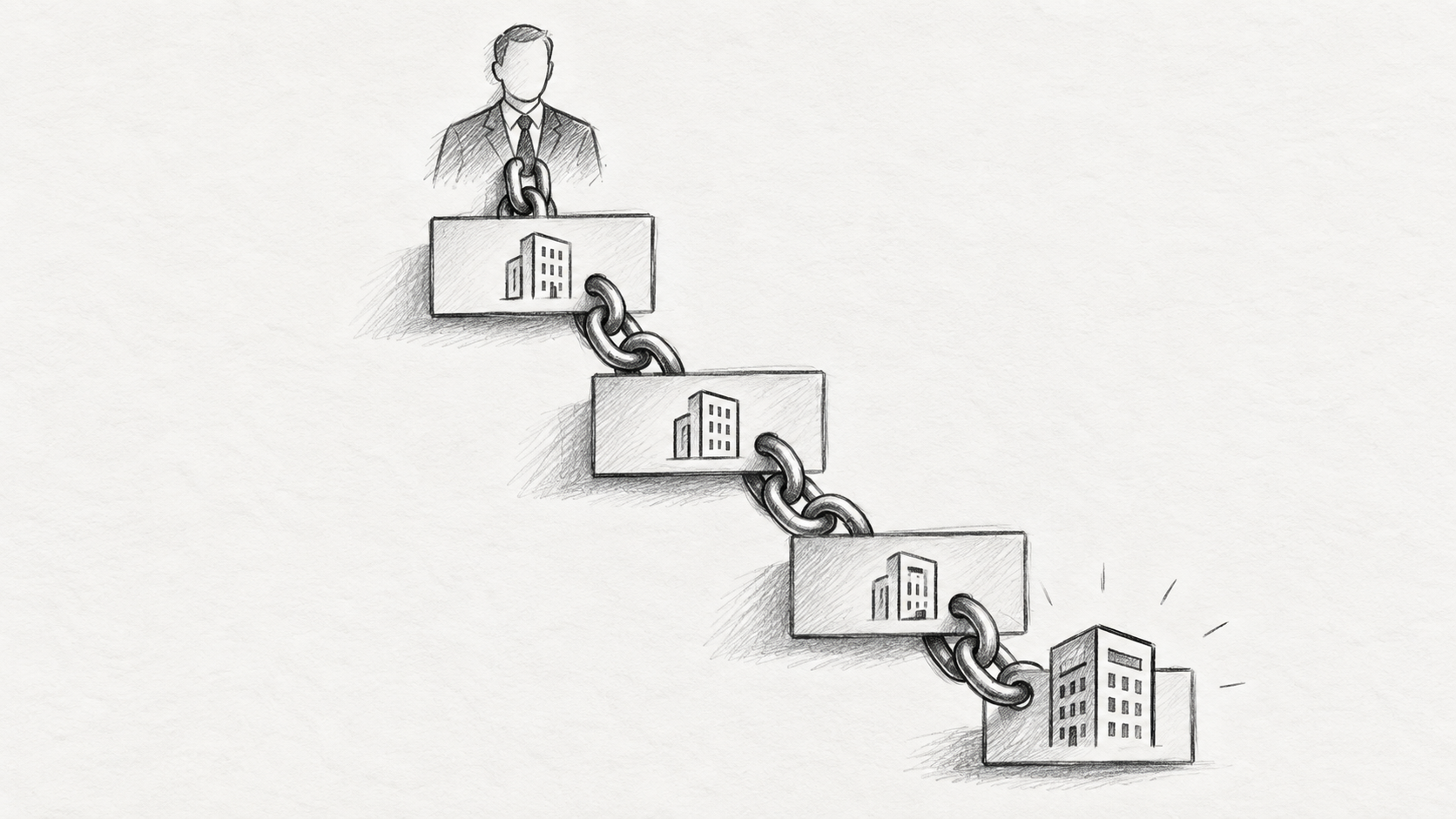
LETA uses the term where control over a company is not exercised directly, but by other means or through several companies or persons (Art. 14 para. 1 LETA). It refers to the entirety of the legal and factual relationships between the reporting legal entity and the natural person who ultimately controls that entity. The Federal Government's explanatory notes on the Ordinance on the Transparency of Legal Entities and the Identification of Beneficial Owners (LETO) describe the chain of control in precisely this sense as the link between the legal entity and its beneficial owner.
The links in such a chain are not limited to companies. Natural persons may also stand between the reporting legal entity and the beneficial owner, for example in a fiduciary arrangement, as may trusts or other legal arrangements (Art. 2 para. 1 LETO). Each of these intermediate links constitutes a level of control. The number of levels in a chain subsequently determines whether the chain itself must be reported.
It is important to distinguish this from the group or corporate structure shown in an organisational chart. An organisational chart shows ownership percentages. By contrast, a chain of control within the meaning of LETA shows the intermediate levels through which control is actually exercised. The two often coincide, but not always, because control can also arise without a significant ownership interest.
How the chain of control relates to indirect control
A beneficial owner is any natural person who ultimately controls the company by directly or indirectly, alone or acting in concert with third parties, holding at least 25 percent of the capital or voting rights, or by controlling the company by other means (Art. 4 para. 1 LETA). The Federal Council has specified when a company is deemed to be indirectly controlled (Art. 6 LETA), and this is where the chain of control becomes legally tangible.
A holding is direct if the capital or voting rights are not held through intermediate persons, legal entities or trusts (Art. 1 para. 1 LETO). It confers control from a threshold of at least 25 percent (Art. 1 para. 2 LETO). A holding is indirect as soon as it is held through one or more such intermediate links (Art. 2 para. 1 LETO). A different threshold applies to indirect control: the beneficial owner must hold more than 50 percent of the capital or voting rights of the intermediate legal entities which, in turn, directly or indirectly hold at least 25 percent of the reporting legal entity (Art. 2 para. 2 LETO).
In practice, this means two different thresholds at two different levels. At the first level, namely for the shareholder that directly holds an ownership interest in the reporting legal entity, the threshold is at least 25 percent. From the second level upwards in the chain, the threshold is more than 50 percent. The explanatory notes on LETO expressly state that the ownership interests at the individual levels are not multiplied. A person who holds 60 percent of a holding company that in turn holds 30 percent of the reporting legal entity is its beneficial owner, even though a mathematical look-through would result in only 18 percent.
Chains also do not necessarily consist solely of ownership interests. Control by other means can likewise be exercised indirectly, namely through one or more intermediate persons, legal entities or trusts (Art. 3 para. 3 LETO). A chain may therefore consist of a majority ownership interest at one level and a right to appoint the board of directors at the next.
Vertical and horizontal chains of control
The explanatory notes on LETO distinguish between two basic forms which may look different in practice but are treated in the same way legally.
A vertical chain of control exists where a natural person holds an ownership interest in a legal entity which, in turn, through majority ownership interests in further intermediate legal entities, holds at least 25 percent of the reporting legal entity. This is the classic case of a tiered holding structure. If a person holds all shares in a holding company and that holding company owns 40 percent of the reporting legal entity, that person is its beneficial owner, and the relevant extent of control is the 40 percent interest held by the holding company in the reporting legal entity.
A horizontal chain of control exists where a natural person controls several legal entities that together hold at least 25 percent of the ownership interests in the reporting legal entity. For example, if a person owns 100 percent of two companies that hold 10 and 20 percent respectively of the reporting legal entity, those ownership interests are aggregated. The person therefore reaches 30 percent and is a beneficial owner even though neither company, on its own, reaches the threshold.
The distinction is more than descriptive. It shows that a company must not consider its shareholders' ownership interests in isolation, but must examine whether several shareholders are controlled by the same natural person. This aggregation is regularly overlooked when the share register is considered purely as a list.
Who is the beneficial owner of a chain of control
Only a natural person can ever be a beneficial owner (Art. 4 para. 1 LETA). The companies and legal entities within the chain are never beneficial owners, even if they hold controlling ownership interests. They are intermediate links whose function is to make the path to the controlling person traceable. If no natural person at the end of the chain meets the requirements, the most senior member of the governing body is deemed to be the beneficial owner on a subsidiary basis (Art. 4 para. 2 LETA).
The situation is different if a trust forms part of the chain. In that case, all natural persons involved in the trust as settlor, trustee, protector, beneficiary or as another person exercising control must be taken into account (Art. 15 para. 1 LETA). If a trustee holds the shares of the reporting legal entity for a trust, these persons must be reported together as beneficial owners, each with their role within the trust structure. A seemingly simple structure with a single shareholder can therefore result in several reports.
The other participants in the chain are not excluded from the obligations. The beneficial owner and third parties involved in the chain of control must cooperate in the verification and provide the company with the required information and supporting documents (Art. 14 para. 3 LETA). The same persons are also subject to a separate obligation to provide information to the control authority (Art. 37 para. 1 lit. c LETA). Anyone who acquires such a position and exercises control through a chain must also report this directly to the company (Art. 14 para. 1 LETA).
What must be reported to the transparency register
In all cases, the identity of the beneficial owners and the required information on the nature and extent of the control exercised must be reported (Art. 9 para. 1 LETA). The Ordinance specifies the content of the report (Art. 20 para. 1 LETO). Regarding the nature of control, the company must determine whether control is exercised alone or acting in concert, directly or indirectly, and through an ownership interest or by other means (Art. 12 LETO). As regards the extent of control, it reports one of three ranges: at least 25 percent up to and including 50 percent, more than 50 percent up to and including 75 percent, or more than 75 percent (Art. 13 para. 1 LETO).
One rule is particularly important for chains of control. In the case of indirect control, the extent of the direct holding in the reporting legal entity must be determined (Art. 13 para. 3 LETO). The decisive factor is therefore not the percentage that the beneficial owner mathematically holds on a look-through basis, but the ownership interest that the directly participating intermediate company holds in the reporting legal entity. Where several persons act in concert, the threshold applies to the ownership interest held jointly, not to each person's individual interest (Art. 13 para. 2 LETO).
When the chain of control itself must be reported
The chain as such does not have to be disclosed in every case. The company only has to obtain information on the natural persons, legal entities or trusts that form part of the chain of control if one of three conditions is met (Art. 15 para. 1 LETO).
- The chain of control includes at least two intermediate natural persons, legal entities or trusts (Art. 15 para. 1 lit. a LETO).
- The chain of control includes at least one trust or fiduciary arrangement (Art. 15 para. 1 lit. b LETO).
- Measures to freeze funds and economic resources under the Embargo Act or the Federal Act on the Freezing and the Restitution of Illicitly Acquired Assets held by Foreign Politically Exposed Persons have been ordered against at least one beneficial owner (Art. 15 para. 1 lit. c LETO).
This results in the distinction that is decisive in practice. If the reporting obligation arises solely from the complexity of the structure, disclosure of the chain only applies from the second intermediate level. If a natural person controls a parent company which in turn directly controls the reporting subsidiary, there is only one intermediate level and, according to the explanatory notes on LETO, the parent company does not have to be reported as part of the chain. The same applies to a horizontal structure with two sister companies because there too only one level of control lies between the person and the reporting legal entity. However, as soon as a trust or fiduciary arrangement is involved, or freezing measures exist, the number of levels is irrelevant. In that case, information on the chain must be obtained from the first level onwards.
Information is then required for every link in the chain. For natural persons, this includes surname and first name, date of birth, nationalities, and municipality, postcode and country of residence (Art. 15 para. 2 lit. a in conjunction with Art. 10 LETO). For legal entities, it includes company name or name, legal form, registered office details and the enterprise identification number (UID) or an equivalent foreign number (Art. 15 para. 2 lit. b in conjunction with Art. 11 LETO). For persons and legal entities acting in a fiduciary capacity, it must also be stated whether they are the principal or the fiduciary (Art. 15 para. 2 lit. c LETO). For trusts, the name, applicable law and identification number must be reported, together with information on the trustee and other beneficial owners and their roles, as well as whether the trust is discretionary (Art. 15 para. 2 lit. d LETO).
This information does not remain within the company but forms part of the report to the transparency register (Art. 20 para. 1 lit. b LETO). It is only deleted once the person concerned has ceased to be a beneficial owner or is no longer involved in the chain of control (Art. 24 para. 3 LETA).
What must be documented within the company
The report is only the visible tip of the obligations. The company must identify its beneficial owners and obtain their surname and first name, date of birth, nationality, address and country of residence, as well as the required information on the nature and extent of the control exercised (Art. 7 para. 1 LETA). It must verify both the identity and the status as a beneficial owner with the due care required in the circumstances and, for this purpose, request relevant supporting documents from shareholders, beneficial owners or third parties (Art. 7 para. 2 LETA).
This information must be documented, kept up to date and stored so that it can be accessed in Switzerland at any time (Art. 8 para. 1 LETA). The retention period is ten years from the time the person concerned ceases to be a beneficial owner (Art. 8 para. 3 LETA). In the case of companies limited by shares and limited liability companies, the person authorised to represent the company who resides in Switzerland must have access to the documented information (Art. 8 para. 4 LETA). In a complex chain of control, this means that the supporting documents for the individual levels must also be accessible and may not be kept only at a foreign group headquarters.
Particular attention is required where identification or verification is unsuccessful. The company must document this fact and the steps taken (Art. 8 para. 2 LETA) and report it together with all relevant information available to it, including information on any chain of control and on shareholders who have failed to comply with their own reporting obligation (Art. 21 para. 1 lit. a LETO). A properly maintained file documenting the enquiries undertaken is therefore not merely a matter of internal organisation, but a prerequisite for a legally compliant report.
Where the practical challenges lie
The greatest difficulty is that the company must collect information that it does not itself possess. Although shareholders and persons involved in the chain have their own reporting and cooperation obligations (Arts. 13 and 14 LETA), the company remains responsible for the report to the register. If an intermediate company is based abroad or an ownership interest is held in a fiduciary capacity, the structure cannot be identified from public registers. The fiduciary professional or lawyer must then reconstruct the chain from agreements, shareholders' agreements, articles of association and confirmations.
In addition, the review does not end with ownership percentages. Control by other means may arise from the right to appoint or remove more than half of the members of the governing or administrative body, from veto rights over key decisions or from the ability to procure profit distributions (Art. 3 para. 1 LETO). It may in particular be exercised through agreements with shareholders, capital instruments such as options or convertible bonds, provisions in the articles of association, legal representation relationships, fiduciary arrangements or relationships between related persons (Art. 3 para. 2 LETO). According to the explanatory notes on LETO, the question of ownership interests and the question of control by other means must be assessed in parallel and cumulatively, unlike the cascade approach under the Anti-Money Laundering Act.
Finally, a chain of control is not a one-off finding. Any change to a fact entered in the transparency register must be reported within one month after the company becomes aware of it (Art. 10 LETA). A change in an ownership interest higher up the chain may alter the report at the base even though nothing has changed in the share register of the reporting legal entity. Anyone who intentionally breaches the reporting obligations may be fined up to CHF 500,000 (Art. 43 LETA). Existing companies are also subject to staggered transitional periods, which become applicable no later than one month after the first amendment to the commercial register entry following the entry into force of the Act (Art. 51 para. 1 LETA).
For fiduciary professionals and lawyers, the challenge is compounded by volume. What can still be dealt with by a file note for a single mandate becomes, across a portfolio of mandates, a question of establishing a repeatable process with a uniform documentation structure.
How Konsento supports you
Assessing a chain of control starts with clean data on the company's own ownership structure. This is exactly where Konsento comes in. The digital share register records the company, shareholders, ownership interests and share classes in a structured form and with a traceable history, so that the basis for identification does not have to be pieced together from Excel files and emails each time.
The transparency register assistant builds on this. It guides companies and advisers through the identification of beneficial owners in a logical sequence and applies the logic set out in LETA and LETO to the recorded structure, from direct holdings and multi-level chains of control to fiduciary arrangements, trusts and scenarios involving control by other means. A graphical representation of the chain of control makes intermediate companies and percentages visible at a glance, facilitating internal review and communication with banks. At the same time, a structured documentation file is created, recording which persons and structures were reviewed and the conclusion reached. If something later changes in the chain, the assessment can be continued on the same data basis and, where necessary, prepared as a report of changes.
Conclusion
The chain of control is the link between a nested ownership structure and the person who ultimately makes the decisions. To read it correctly, two thresholds at two levels must be kept in mind: at least 25 percent at the first level and more than 50 percent from the second level upwards, while the ownership interests at the individual levels are not multiplied (Arts. 1 and 2 LETO). The natural person is always the person reported, together with the nature and extent of their control, with the extent determined by the direct holding in the reporting legal entity (Art. 13 para. 3 LETO).
The chain itself only becomes visible to the register when the structure has at least two intermediate levels, when a trust or fiduciary arrangement is involved, or when freezing measures exist (Art. 15 para. 1 LETO). Irrespective of this, the company must be able to substantiate its enquiries at all times, keep them accessible in Switzerland and retain them for ten years (Art. 8 LETA). The main effort therefore arises less from the report itself than from structured data collection and ongoing maintenance.
Next Steps
If your company is held through a holding company, several investment vehicles or a fiduciary arrangement, it is worth mapping the chain of control properly now and collecting the supporting documents in one place. Konsento helps you keep the ownership data in a structured form, identify the beneficial owners in a traceable manner and prepare the report to the transparency register together with the documentation.