

AirVault webflow template image

Swiss e-ID: The Digital Identity Key to Efficient Corporate Actions

The new Swiss e-ID marks a major step in the digitalisation of corporate legal processes. It enables secure, state-verified identification and builds trust in Corporate Actions such as general meetings, capital increases, and notarizations. In this first part of the series, we show how Konsento integrates the e-ID to streamline identity verification, enhance legal certainty, and pave the way for fully digital corporate governance.
AirVault webflow template image

Capital increase by debt conversion: a restructuring tool for overindebted Swiss companies

When a Swiss AG faces overindebtedness, a capital increase by debt conversion can restore financial stability. Discover the legal framework, pros and cons, and how Konsento enables a fully digital process.
AirVault webflow template image

Capital increase with convertible loans: preserving confidentiality and avoiding mistakes

Many boards of directors underestimate that during a capital increase by setting off a convertible loan (Convertible Loan Agreement – CLA), investor identities must be disclosed in the articles of association – a major breach of confidentiality. This article explains the differences between ordinary, authorized, and conditional capital increases, showing why only the latter truly protects shareholder privacy. Companies using CLAs should therefore establish conditional capital early on to avoid mandatory disclosure.
AirVault webflow template image

Closing the Funding Round – Which Resolutions Do You Need for the Capital Increase?

Before a funding round can be completed, the right shareholder and board resolutions are essential. This video explains the key types of capital increase – from the ordinary capital increase to the capital band – and how convertible loans can be offset. Swiss startups learn how to structure, document, and notarise resolutions correctly to reach a compliant closing. Konsento supports founders through every stage of the process – digital, efficient, and secure.
AirVault webflow template image

Closing the Funding Round – What Founders Need to Prepare

Before the closing of a funding round, preparation determines whether the process runs smoothly or causes costly delays. This video explains how Swiss startups can properly prepare their capital increase – from general meeting and board resolutions to subscription forms and commercial register filings. Konsento demonstrates how to handle every step digitally and in full compliance, building investor trust and ensuring an efficient, legally sound closing.
AirVault webflow template image

Legal Due Diligence for Companies in Switzerland: How to Prepare Effectively

In Switzerland, every funding round requires a Legal Due Diligence – for both startups and established SMEs. Investors and Business Angels review the share register, articles of association, contracts, and participation plans before committing capital. For entrepreneurs, board members, and CFOs, careful preparation is crucial to demonstrate reliability and “investability.” Konsento provides a digital solution to centralize documents, identify gaps, and present an Investment Readiness Report to investors.
AirVault webflow template image

Legal Due Diligence: What Founders Need to Know
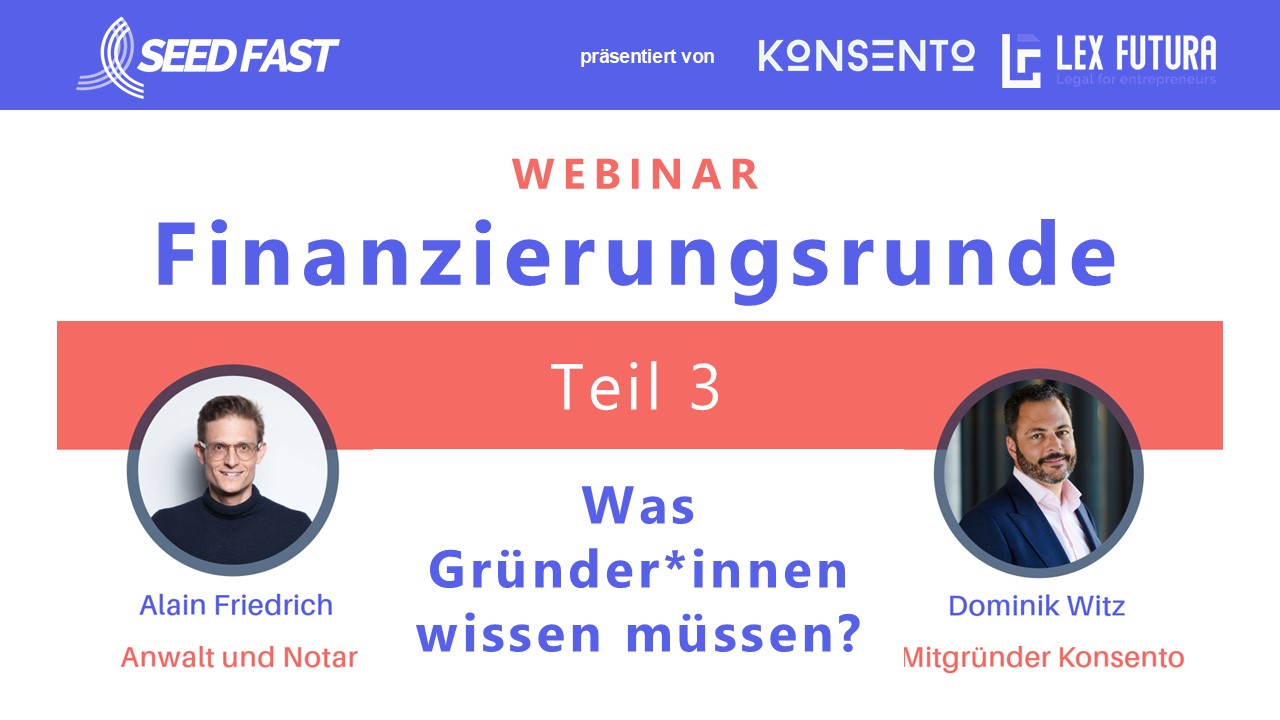
Legal due diligence is a key step in every seed funding round in Switzerland. This video explains which documents investors expect, how to set up a data room, and why disclosure and warranties in the investment agreement are essential. Perfect for founders and startups preparing professionally for their funding round.
AirVault webflow template image

Understanding the Term Sheet: What Swiss Founders Need to Know Before Signing

The term sheet defines the economic cornerstones of a financing round — valuation, vesting, liquidation preferences, control rights. This compact webinar shows what startups should pay attention to before they sign.
AirVault webflow template image

How Startup Funding Rounds Work in Switzerland – A Clear Overview for Founders and Startup Teams

In this first SeedFast webinar, Lex Futura and Konsento provide a clear overview of the structured process behind a typical pre-seed or seed funding round. Perfect for founders, board members and startup teams who want to understand what’s involved – from initial investor talks to the final entry in the commercial register.
AirVault webflow template image

What types of capital increase are there in Switzerland? Startup guide

This webinar provides a quick overview of the common forms of capital increase in Switzerland — from ordinary increases to capital bands to conditional capital increases. Ideal for founders who are planning a seed financing round.
AirVault webflow template image

The nightmare of a capital increase: The closing as a bottomless pit!

The completion of a capital increase can quickly become a bottomless pit: Incorrect data, unclear investor structures or chaotic spreadsheets drive costs and effort immeasurably. Learn how to avoid these pitfalls with Konsento and manage your capital increase efficiently and stress-free!
AirVault webflow template image

What needs to be done immediately after the capital increase? After the capital increase is before the capital increase

After a capital increase, the work does not end with the entry in the commercial register. Companies must immediately start their corporate housekeeping: from updated share registers to communication with existing and new investors to clean documentation of all transactions. Those who complete these steps promptly create clarity, transparency and trust — and save themselves considerable expenses later on during general meetings, due diligence or other capital measures.
AirVault webflow template image

Subscription rights explained in simple terms

Subscription rights protect shareholders from dilution of their shares and voting rights in the event of capital increases in a public limited company. The article explains how subscription rights work for shares and participation certificates, when they may be restricted or abolished, and what formal requirements apply. In addition, the consequences of violations are explained and how digital solutions such as Konsento make the process efficient and legally compliant.
AirVault webflow template image

What Is a General Meeting with Written Voting and Which Companies Is It Suitable For?

General meetings with written voting – known as universal meetings or circular resolutions – provide Swiss corporations with an efficient alternative to traditional shareholder meetings. They allow resolutions to be passed on paper or electronically, without shareholders being physically present. This article explains the legal framework, the differences between universal meetings and circular resolutions, and why these forms are particularly suitable for smaller companies and startup capital increases.
AirVault webflow template image

How Does a Capital Increase Work? The Complete Step-by-Step Process

Capital increases are one of the key growth drivers for Swiss companies – over 4,000 are carried out every year. This article walks you through the process step by step: from financing simulation and shareholder resolution to notarial certification and commercial register filing. It highlights the legal complexity involved and shows how digitalization makes the process much faster and more efficient. With Konsento, companies can now complete a capital increase fully online – including meeting organization, investor commitments, automatic document generation, and remote notarization – saving up to 50 % in time and costs.
AirVault webflow template image

rheo-CEO Philipp Vetter: “I hardly had to deal with the administrative tasks of my capital increase”

rheo AG digitises vital-sign monitoring with wearable sensors and predictive analytics. In 2023, the company structured a convertible loan with 30 new investors, converted it into shares, increased its share capital and consolidated investors into two syndicates. In this interview, CEO Philipp Vetter explains how Konsento supported the entire process: legal alignment, synchronisation of contracts, automated document generation and coordination of the notarial certification. The outcome: a fast, reliable execution with major administrative time savings for the rheo team.
AirVault webflow template image

What does the company management need to consider before and during equity crowdfunding?

Equity crowdfunding offers companies new opportunities for financing and community building, but it also entails extensive formal requirements before, during and after the campaign. This article outlines the key legal and organisational steps – from capital increases to subscription forms, notarisation and shareholder management – and explains how Konsento supports companies in making the entire process efficient, compliant and seamless.
AirVault webflow template image

Capital increase in Swiss stock corporations

A capital increase is a key instrument for financing the growth, investments or restructuring of a public limited company. The article explains the three forms provided for in Swiss stock corporation law — ordinary capital increase, capital band and conditional capital increase — and highlights their differences in flexibility, requirements and applications. Finally, it is shown how Konsento digitizes implementation and saves companies time, costs and errors — from preparation to notarization to entry in the share register.
AirVault webflow template image

The importance of corporate governance for companies in equity crowdfunding

Equity crowdfunding enables companies to raise capital while turning customers into engaged co-owners. To manage this growing community, strong corporate governance is essential: transparent reporting, clear shareholder rights, independent oversight and consistent processes – including specific rules for participation certificate holders. The article outlines these obligations and highlights how Konsento enables companies to handle governance efficiently and compliantly, even with hundreds or thousands of investors.
AirVault webflow template image

Corporate restructuring without fixed interest payments and dilution of voting rights

Participation capital with preferential rights offers Swiss joint-stock companies an attractive financing form between equity and debt. It strengthens the company’s equity base without diluting voting rights and allows flexible investor compensation through preferred or cumulative dividends. Companies maintain independence while investors are fairly rewarded for their risk. With Konsento, capital increases involving shares and participation capital can be fully planned, notarized, and registered online – efficiently, securely, and with minimal administrative effort.
•
FAQ

Frequently asked questions

Who within the company is responsible for determining beneficial ownership and carrying out the verification with the required due care?

The most senior member of the governing body. That person may delegate the task but remains responsible for the proper filing of the report (Art. 12 LETA).

What happens if a shareholder does not cooperate in determining the beneficial ownership?

The company documents the steps it has taken (Art. 8 para. 2 LETA) and states in the report that the verification was unsuccessful (Art. 9 para. 3 LETA, Art. 21 LETO). An intentional breach of the cooperation and reporting obligations may result in a fine of up to CHF 500,000 for the shareholder concerned (Art. 43 let. a LETA).

Is a copy of an identity document always required?

The company must establish whether the person concerned has an OASI number. Only if that is not the case must it obtain a copy of the passport, identity card or foreign national identity card (Art. 10 para. 2 LETO).

Get Started Today and Streamline Your Workflow

Join thousands of satisfied users who have transformed their workflow with AirNode. Sign up now and take the first step towards.

By clicking Sign Up you're confirming that you agree with our Terms and Conditions.
Thank you! Your submission has been received!
Oops! Something went wrong while submitting the form.